Janáček described his nature-versus-humanity fable The Cunning Little Vixen as “a merry thing with a sad end”. In which case, the even stranger Makropulos Case is a chattery legal mystery with a transcendent end as the 337-year-old (437 in this update) protagonist decides life only has meaning within its natural span and rejects the formula she's come for.
You don't feel the transcendence from director Katie Mitchell, who complicates an already wordy text with a whole new subplot where minor character Krista falls in love with Emilia Marty.
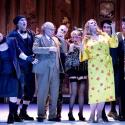
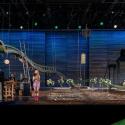
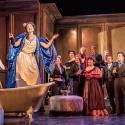
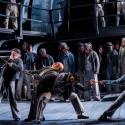
Although the original play was also written by a man, the fantastical Karel Čapek, the sympathy comes and goes for this woman who was forced to take the potion of eternal life as a girl, and who has been used and abused by men over the centuries. You only hope that sense will eventually emerge from the constant irritation of internet exchanges between Marty, Krista and the boyfriend whom Krista is using to nose out valuable documents in the singer's bedroom they can sell to get to Berlin; all the while the legal complications of "Causa Gregor-Prus" which have dragged on over years like Dickens' Jarndyce v Jarndyce, hard to grasp at the best of times, get lost. Krista's there nearly all the time, doing the strangest things, and the final payoff (pictured below) is a dud: all the more disappointing when you remember how the supernatural picture opened up in productions by Nikolaus Lehnhoff at Glyndebourne and Christopher Alden at English National Opera. 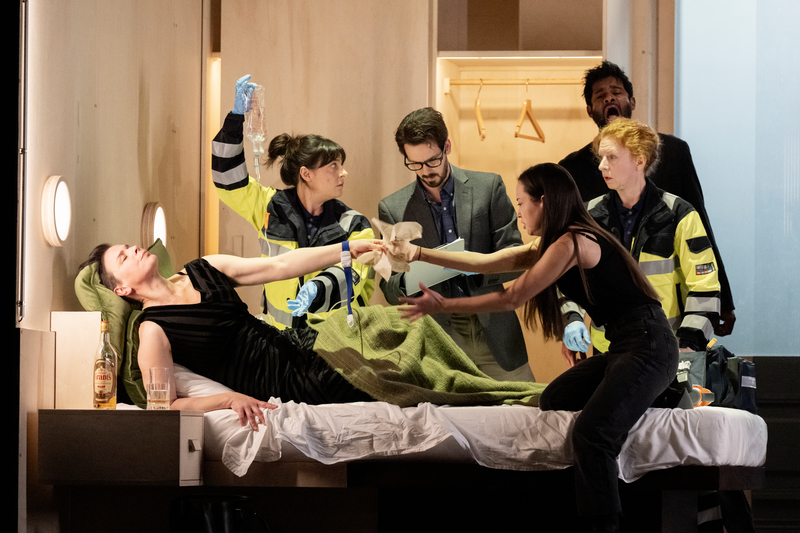 Because the simple fact is that the subject, which suits Janáček's jagged interchange of romantic lyricism and modernistic effects daring even for the 1920s, isn't just about a woman, or women. True, in the erotic exchanges with various men, you understand why she manipulates them. But the essence would be the same if, say, "she" were a famous tenor. It may have been because I was sitting in the upper circle, able to hear every word (despite Vicki Mortimer's set-back rooms, a familiar device for Mitchell) but not to see the facial expressions that Ausrine Stundyte'e Marty felt one-dimensional. This is a voice more suited to what Verdi wanted for his Lady Macbeth – hollow and stifled – than for an ageless beauty who has to blossom in her final outpouring.
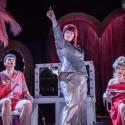
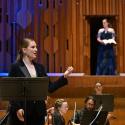
Other fine singers seem under-defined in their characters, starting with Peter Hoare's legal clerk Vitek and extending even to the usually charismatic Sean Panikkar as Albert Gregor and Johan Reuter's Baron Prus. The young lovers are nicely sung by Heather Engebretson (pictured below with Stundyte) and Daniel Matoušek, but way too many implausible things happen to them (I won't spoil the silliest).  Which leaves the revelations, predictably, to Jakub Hrůša in his second production as Royal Opera Music Director, and the orchestra which burns for him. Time and again, starting with the Prelude and its ancient brass fanfares, the impetus is defused by the staging, but we still hear every extraordinary detail, like the shrieking piccolos and snarling muted trombones, register with unparalleled vividness. And we almost take it for granted that the quick-fire lines from the singers mesh with the orchestra; the timing is perfect. What a missed opportunity that the stage drama isn't up to it.