Of all Romantic operas, La Bohème is perhaps the one that responds best to what one might, for want of a better phrase, call straight theatrical treatment. It’s pure genre: no hidden meanings, no contemporary significance. “Scenes from the life”, as Murger called his book, now barely readable. Puccini’s opera, likewise, is short on continuity, long on atmosphere, very long on sentiment. Why would anyone bother with it?
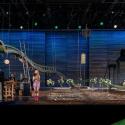
Annabel Arden’s new production for WNO answers that question more than convincingly. She makes no great statements; we’re not lectured on art as redemption or disease as moral sickness. The action is not transported to the White House or the Welsh Assembly, Rodolfo is not reimagined (if that’s the right word) as Andrew Motion locked in an affair with Amy Winehouse. Instead we are in a Paris garret, perhaps a shade more recently than Murger, but not damagingly so; there is a big window, a chair and a stove. Momus is still in business. The marketers still need passports to get into the city at dawn. The artists starve and the snow falls. God’s in his heaven.
I don’t know any operatic act that’s so prodigal with snatches of marvellous ideas thrown away like casual conversation
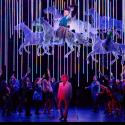
I enjoyed this production and found it touching and very much to the point. Arden tweaks things here and there. Her Mimi blows her candle out deliberately (twice), which I think is a gloss on Puccini, though an entirely plausible one. The last act seems to be in a slightly different garret from the first – and maybe just, in its barrenness, there is the faintest hint of a symbolic point about the death of the heart, except that, here especially, the heart doesn’t die but somehow outlives the squalor and the seeming futility of young love. The designer, Stephen Brimson Lewis, comes up with a witty and effective adaptation of the front drop, into something like a Victorian Christmas card that opens out from a diamond-shaped centre aperture on to each scene. This both captures and defuses any sentimentality; I found it charming.
But needless to say the reason why the question is answered lies with the music. Puccini will always have his high-minded critics, but musicians know that few composers have had his mastery of the theatrical genre: his genius for dramatic pacing, his quality of ideas immaculately presented, his sheer expertise with the medium. Audiences have always known this as well, by the way, but shamefacedly, as if it were an unserious preference. In fact it shows excellent taste, though one might wish they could grow out of cheering “Che gelido manina” and (always slightly less spontaneously) “Mi chiamano Mimì”, as if it were part of the score.
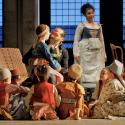
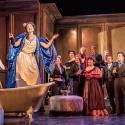
Musetta’s waltz is a different case, because the sheer brilliance of the scene – the people, the children, the onstage band – draws us in as part of the crowd, and if we cheer then (we didn’t this time) we become temporary extras, part of the setting. I don’t know any operatic act that’s so prodigal with snatches of marvellous ideas thrown away like casual conversation, except possibly in Verdi’s Falstaff – a recent work that must have influenced Puccini. And how concise it all is! You could get most of La Bohème into one act of Tristan, WNO’s last offering. Yet Puccini is inconceivable without Wagner.
 Carlo Rizzi, the company’s former music director, has conducted Wagner here, but Puccini is his element. He has an Italian’s natural instinct for the lyrical flow combined with discreet symphonic texture that was more or less a Puccini invention. The orchestra play for him as if the music were in their veins. And if balance with the stage was mildly awry here and there, that was partly the director’s fault for upstaging her singers at tricky moments. This is a big theatre, while for singing Bohème the lyrical and the sprightly are more essential than the robust.
Alex Vicens, the Rodolfo, is an occasional victim, with his somewhat pinched upper register and small physique, though both technically and emotionally he’s well on top of the music, and a sensitive, engaging actor. His love episodes with Anita Hartig’s Mimì are genuinely affecting, while never losing sight of their ephemeral quality of a one-night stand. No Liebestod in this garret, even if Rodolfo does let rip a tiny spot in C sharp minor over her corpse. Hartig, a Romanian soprano not heard here before, is something of a find, exquisitely tender onstage, with a lovely, easy top register, and needing only perhaps a touch more projection in the middle of the range. Theirs may be a shortlived passion, but it’s intensely felt, and here perfectly natural.
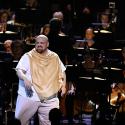
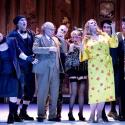
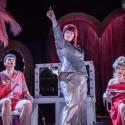
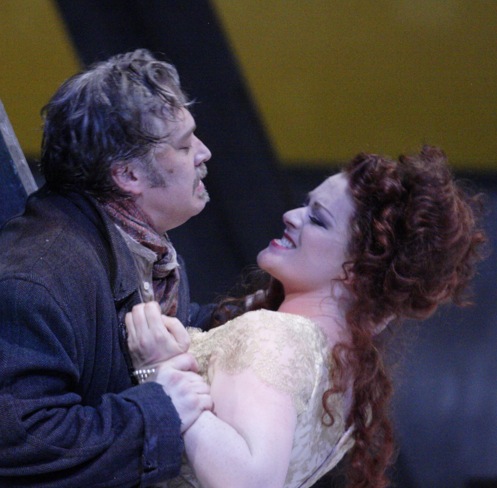
The support is strong. David Kempster (pictured above with Kate Valentine) is a fine, unapologetic Marcello, almost a second hero, and Kate Valentine makes a stylish Musetta, though on this opening night her waltz didn’t quite take off as it can and probably will. David Soar parts with Colline’s coat rather movingly (and uselessly: Mimì is dead by the time he comes back with the cash – somehow this is Bohème in a nutshell). Gary Griffiths is a witty, arty Schaunard. The WNO chorus sparkles as ever at the Café Momus, the inevitable mixture of weirdos, trannies, Parpignol the pedlar (Michael Clifton-Thompson) as a chimpanzee, but all straight as soon as they open their mouths.
- La Bohème at Wales Millennium Centre on 3, 6, 8, 9 June, and Birmingham Hippodrome on 13, 14, 15 June