Wagner’s Tristan left a huge mark on fin de siècle art, on the symbolist poets, even on their pseudonyms; Debussy himself toyed with a four-act opera on the subject. And his version, if he had ever composed it, would have been an intriguing precedent for the Swiss composer Frank Martin’s Le Vin herbé (The Drugged Wine), since both are, or would have been, derived from the same source, Joseph Bédier’s turn-of-the-century novel, Le Roman de Tristan et Isaut, a much more detailed and anecdotal conflation of the various medieval legends than Wagner’s.
Martin’s so-called Oratorio profane (1938-41) was not composed for the stage and has seldom found its way there, at least in this country. But Polly Graham’s new production for Welsh National Opera shows, among other things, that the hour-and-three-quarters piece is both stage-worthy and, in its own fashion, distinctly dramatic.
True, it goes out of its way to avoid the normal apparatus of operatic drama. Scored for a tiny orchestra of solo strings and piano, and with most of the vocal solos supplied by singers stepping out of the chorus, it studiously rejects theatre and characterisation in the normal sense. Only Tristan and Iseult (Martin’s spelling) are consistent portraits from start to finish. The text is mainly a poetic narrative, told by the chorus, and the form is a mosaic of brief tableaux, twenty in all, a sort of child-adult’s home theatrical, but surprisingly intense as a whole, and in the end subtly moving.
It would be hard to imagine a more perfect musical performanceMartin’s score is exquisite and effective, even if a shade too long for its somewhat limited harmonic and instrumental palette. Something of Wagner remains, though refracted through Schoenberg’s serialism. But the sensibility is entirely French, with occasional shades of Debussy’s Pelléas in certain harmonic archaisms and the discreet, speech-like setting of the text. I thought it a pity that WNO decided to sing it in English, which lies less well on the music and to some extent betrays the poetic quality of the original French. But the gain in clarity, with the little orchestra upstage, though very much visible behind the singers, was a notable compensation.
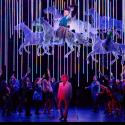
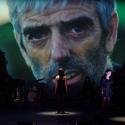
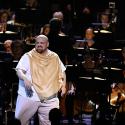
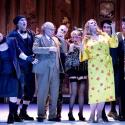
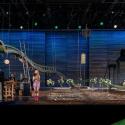
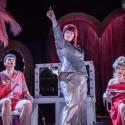
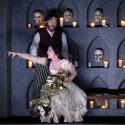
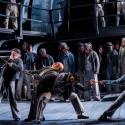
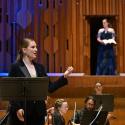
Graham’s staging is efficient rather than stylish, costumed modishly in flat modern dress (designer April Dalton), where an element of – not necessarily medieval – strangeness might seem to be called for, and with gantries and ramps and canvas chairs in lieu of scenery. But it would be hard to imagine a more perfect musical performance, starting with the hyper-refined instrumental playing under James Southall, and with solo singing, including by chorus members (Rosie Hay, Howard Kirk, among several others), almost without blemish.
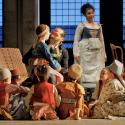
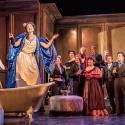
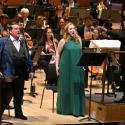
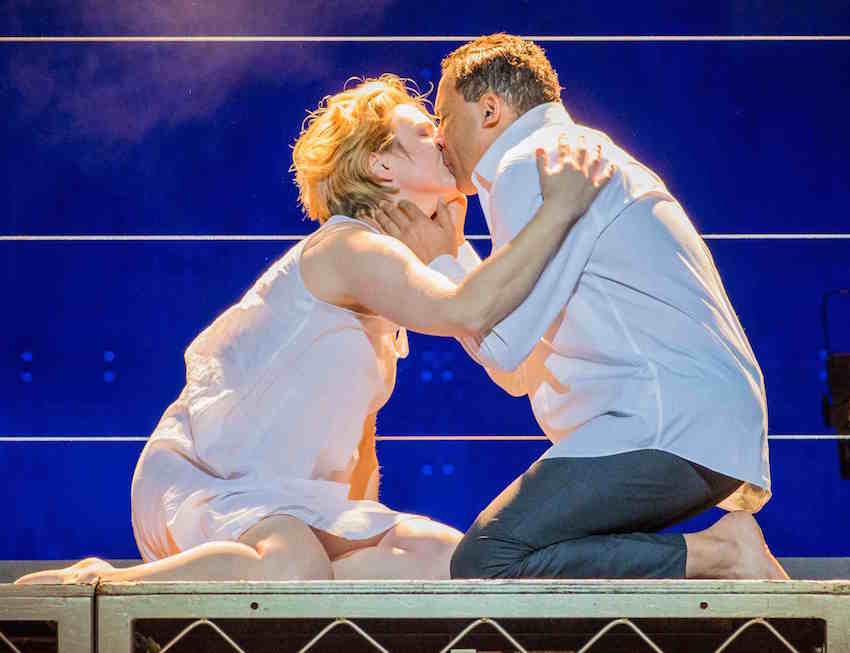 Both the solo principals were previously unknown to me. The Australian mezzo Caitlin Hulcup (pictured right with Tom Randle), though unflatteringly wardrobed, sings the soprano role of Iseult so arrestingly and with such beauty of tone and expression that one simply lets the music blot out the visual image. The Tristan, Tom Randle, is marginally less immaculate, and a slightly apologetic actor in a role that needs some air of, albeit damaged, authority. All the same, this is a thoughtful and touching portrait musically, short on Wagnerian hysterics, long on reflective detail, especially in the big monologue where he discusses with himself the significance of King Mark’s failure to murder the two of them when he finds them asleep side by side in the forest.
Should Le Vin herbé be repertory? Done, as here, in a single act without interval it makes for a fairly sombre evening, with many beauties of sound and incident but some lack of emotional variety. A lighter companion, in the manner of an after-piece, would help relieve the gloom, as would a more colourful, less ruthlessly functional staging. I’ve no quarrel with Le Vin herbé as theatre in itself. But it’s not for faint hearts.