Martin Duncan’s 2008 production of A Midsummer Night’s Dream remains one of the best and funniest things Opera North has ever done – back now again (it was also seen in 2013-14), in the company’s autumn season of revivals.
The idea, hinted at in the staging and suggested in its original publicity, that Britten’s vision of Shakespeare’s enchanted world could be presented in terms of “psychedelia” and even likened to an acid trip, on the grounds that those things were part of the 1960s and Britten completed his opera in 1960, is, strictly speaking, a minor anachronism. Such things came late in the decade, not at the beginning of it … though you might suggest that Britten was ahead of his time, I suppose.
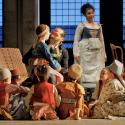
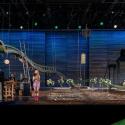
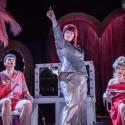
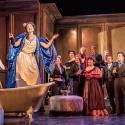
But the thing is that it works anyway, and the panels and shifting sheets of translucent Perspex (and the hovering pieces of giant Bubblewrap over the stage), together with the costumes of Ashley Martin-Davies – glittery for Oberon and Tytania, garishly colourful and sixties-style patterned for the young lovers – are as good a setting as any attempt at a forest and its people. 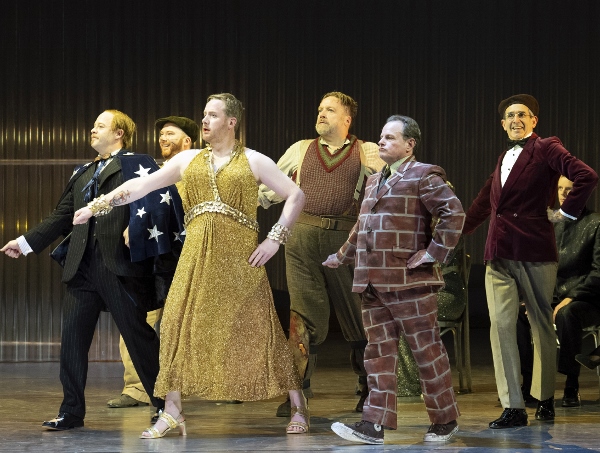 The costumes, with the fairies in white with identical blonde wigs like the children in Village of the Damned (an idea from the original 1960 production at Aldeburgh), and Shakespeare’s comic “mechanicals” in contemporary dress according to their trades, are vital to its visual impressions, and it’s appropriate to remember that when the production was new it was one of three Shakespeare-based operas created by this company with a common designer. Johan Engels had to allow for the possibility that any two might be staged on the same day, matinee and evening, so there wasn’t much scope for traditional sets. And he had a limited budget, too, as he bewailed when I interviewed him about it at the time.
The result was that everything depended on the performers’ skills, and it still does. With Matthew Eberhardt as revival director and a very well chosen cast, that has made this presentation a complete success.
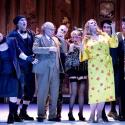
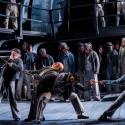
Since Britten and Peter Pears simply used Shakespeare as their librettist, they could hardly go wrong, and I loved the comedic part of this production most on previous occasions. The send-up of amateur theatre presented in the “most lamentable comedy” of Pyramus and Thisbe (pictured above) is wonderfully done: there are plenty of clever details such as the group hug shared by the mechanicals before they start their show, and their hilariously disjointed “bergomask” dance at the end (choreography credit to Ben Wright).
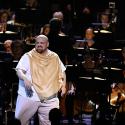
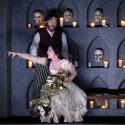
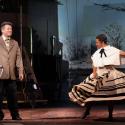
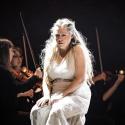
The most welcome thing is that Henry Waddington is back for the third time as Bottom the weaver. When he had to omit the tour performances last time round we certainly missed his manly form, and his theatrical instincts and sheer vocal quality are still the highlight of the show. He’s well backed up by Dean Robinson (Peter Quince), Nicholas Watts (Francis Flute), Frazer Scott (Snug the joiner), Colin Judson (Snout the tinker) and Nicholas Butterfield (Starveling the tailor). Daniel Abelson reprises his at times almost Gollum-like speaking role of Puck, too, to excellent effect. 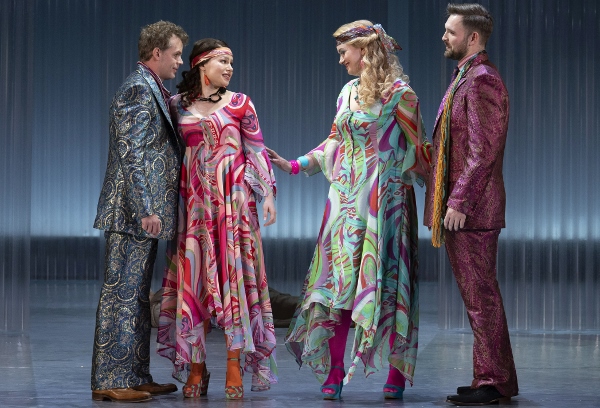 The youngsters are Siân Griffiths as a feisty Hermia, Camilla Harris as a delightful Helena, James Newby as a likeable gormless Demetrius, and Peter Kirk as an endearingly dumb Lysander – all delivering the musical goods with skill (pictured above). James Laing and Daisy Brown are well-matched (if ill-met by moonlight) as Oberon and Tytania, and Andri Björn Róbertsson and Molly Barker make an imposing Theseus (I liked his imitation-royal comment to the lion to “Make him roar again” in the Pyramus and Thisbe scene) and Hippolyta. The children’s chorus of fairies do their songs and a lot of dance moves very well, with Kitty Moore, Dougie Sadgrove, Lucy Eatock and Jessie Thomas confident little characters.
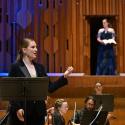
Opera North’s music director Garry Walker handles the score deftly – the first string glissandi scarcely audible as the world of magic and sprites comes into view, but the rest full of life, precision and energy.
- Further performances on 19, 24 and 31 October at Leeds Grand Theatre, 6 November at Newcastle Theatre Royal, 13 November at The Lowry, Salford, and 20 November at Nottingham Theatre Royal