Brecht – as I suppose he intended – is always a shock to the system. With not a word on what to expect from his commitment to the strictures of epic theatre in the programme, a star of West End musical theatre cast in the lead and a venue with a history of more user-friendly shows, some are going to have to sit up straight in their seats from the very start – including your reviewer.
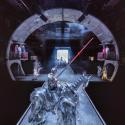
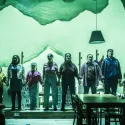
This new production, the first in London for 25 years, opens on a present day refugee camp, displaced people squabbling over who gets to go home first and what support they can expect when they get there. The names (and the play’s title) suggest the Caucasus, so has the conflict between Azerbaijan and Armenia flared up again? But the names are Georgian, so are we in a future in which Russia has invaded that tiny fearful republic once again? Or is the story more universal and we’re at liberty to consider our desperate men and women as any individuals running from conflicts longing to return home?
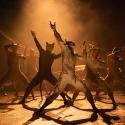
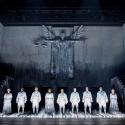
 One can see why the framing device isn’t always used because such thoughts are still in mind well after The Singer (Zoe West) turns up, the bickering stops and the play-within-a-play begins. Director, Christopher Haydon, has chosen not to use the traditional banners to introduce each episode and does not to keep all his actors and stagehands in plain sight, so the comforts of Brecht’s more obvious non-naturalistic paradigm are denied us and we take more time orienting ourselves to all these characters coming and going. There are more than 50 for the nine actors to create and some of the short cuts used to meet that considerable challenge don’t work. There’s the singing too, but much of it is done initially by The Singer to her own accompaniment and, inescapably, it feels a little like a busker has decamped from the high street and is working the room.
Grusha, a maid, has rescued a baby boy left behind when her mother, the governor’s wife, flees a city disintegrating during conflict. As heir, the baby’s life is endangered by different factions, so Grusha heads for the mountains, her bond with the child strengthening as they deal with the chaos in the countryside and the friends and foes (mainly foes) they run into. Ultimately, she faces a kangaroo court (there is no other kind in this place – nor in ours, the implication) and her love goes up against the governor’s wife’s blood in the circle of the title. Who is the real mother in such circumstances?
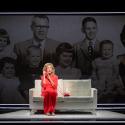
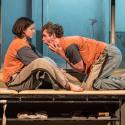
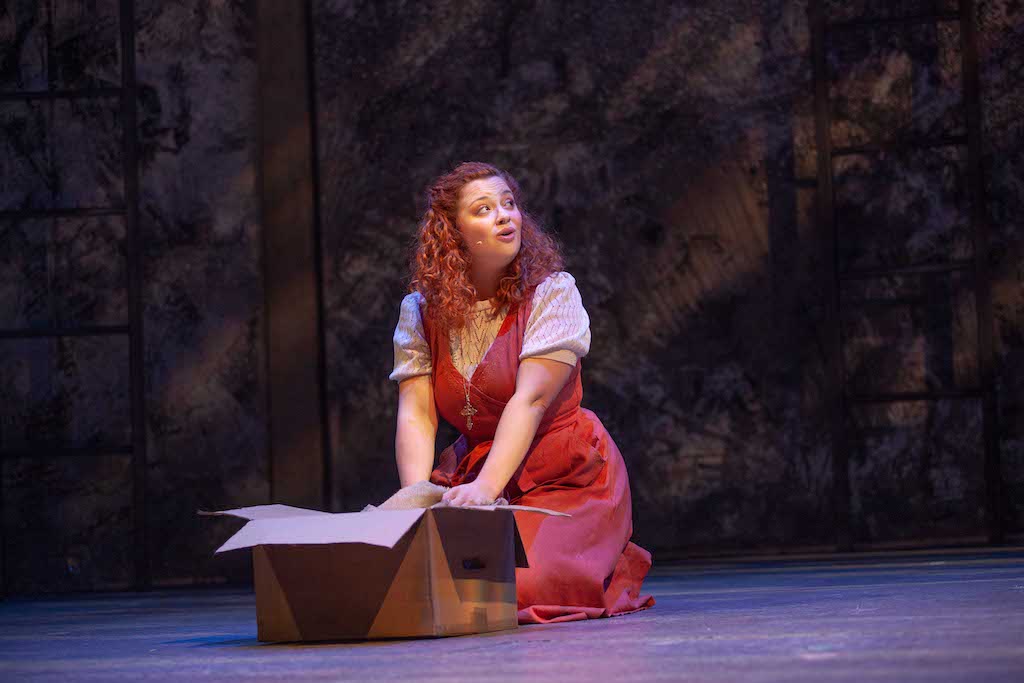
Adapter, Steve Waters, does not compromise on our comfort. The first half is a long haul – 90 minutes – and the songs are not a great relief, Michael Henry’s melodies largely lacking in catchy hooks and, with just a strumming guitar to work with, they soon irritate as much as they entertain. The exception, as one would expect, comes when Carrie Hope Fletcher’s Grusha (pictured above) sings and her emotional turmoil emerges fully into the light. But, alas, her wonderful voice is severely underused.
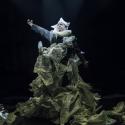
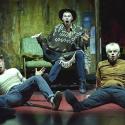
Taking a deep breath to return for the second half – the show runs to a demanding, some might say indulgent, three hours including the interval - much needed comic relief is provided by the sardonic wit of Jonathan Slinger’s Azdak, the only literate man in the town and, via an unlikely turn of events including his rescue from the gallows, the judge for the court convened to decide on the fate of the child. It’s in the character of Azdak that the power of regularly breaking the fourth wall, of treating wholly absurd situations as serious, of language to turn minds, becomes evident, Slinger milks it of course, but to winning effect, eliciting his fair share of laughs from the house.
Though it’s a tough proposition to bring forward so many characters from a relatively small pool of actors, it’s disappointing that regional accents (many very wobbly) are still used as markers of an unsophisticated proletariat. We get that this is a country populated by peoples with different histories and interests, maybe even different ethnicities, but it’s such a hackneyed device to use in 2022.
While it’s good to know that, even in these most financially straitened of times, a mid-sized, off-West End house like the Rose Theatre can mount its own production of a monument of Brechtian theatre, it’s disappointing to discover that it’s so tough to love. It really doesn’t have to be this hard.