There’s cruel comedy and human drama aplenty in Fortune’s Fool, so much so that it’s hard sometimes to know whether we’re watching farce or tragedy. But it’s a mixture that works well in Lucy Bailey’s production of Ivan Turgenev’s early play in this version by Mike Poulton, making its London debut at the Old Vic.
Fortune’s Fool has a rather special history behind it. Poulton’s adaptation of Turgenev’s 1848 work was first seen in Chichester in 1996, to mixed critical reception. Thanks to Alan Bates, who had played the central role of the tragic Russian country estate hanger-on, Vasily Kuzovkin, it reached Broadway a decade ago directed by Arthur Penn, where it won accolades. Bates and Frank Langella, playing the manipulative neighbouring landowner Tropatchov, who competes with Kuzovkin for stage attention, both came away with Tony and Drama Desk awards.
Glen’s second-half revelations reach a Chekhovian intensity
Their roles at the Old Vic go respectively to Iain Glen, bringing real depths of emotion to the washed-up Kuzovkin, and Richard McCabe as Tropatchov, who relishes a comic fight – in the most sadistic way, for his own amusement – even if it's with an opponent whom he knows to be far weaker. As their interaction proceeds, a wider human drama unfolds which shines light onto the past history of the returning owner of the estate, Olga (Lucy Briggs-Owen) and her young husband Pavel (Alexander Vlahos), newly arrived from St Petersburg.
There's a lovely opening scene, as we watch the house servants going about their business around a huge wardrobe, from the upper shelf of which Glen’s Kuzovkin emerges: it’s where this lost "little man" character, whose ancestry lies in Gogol, adopted into estate life decades previously by the last master as something of a house fool, has taken to sleeping. Despite all that has changed over the years Kuzovkin has never left the place, living out a frugal life while the court case about his own estate inheritance drags on (in inimitable Russian style). For company, he has at least had a friend in another impoverished landowner (John McAndrew), while he’s just about tolerated by the estate’s servants.
 That below-stairs world is vividly portrayed, somehow gaining new intonations post-Downton Abbey. Chief steward Nartzis (Daniel Cerqueira) presides, with an accent and unctuous demeanour that wouldn’t be that out of place in a Carry On! film. But the most assertive presence is chief footman Pyotr (Dyfan Dwyfor), who makes it clear he’s long established his own autonomy in this territory.
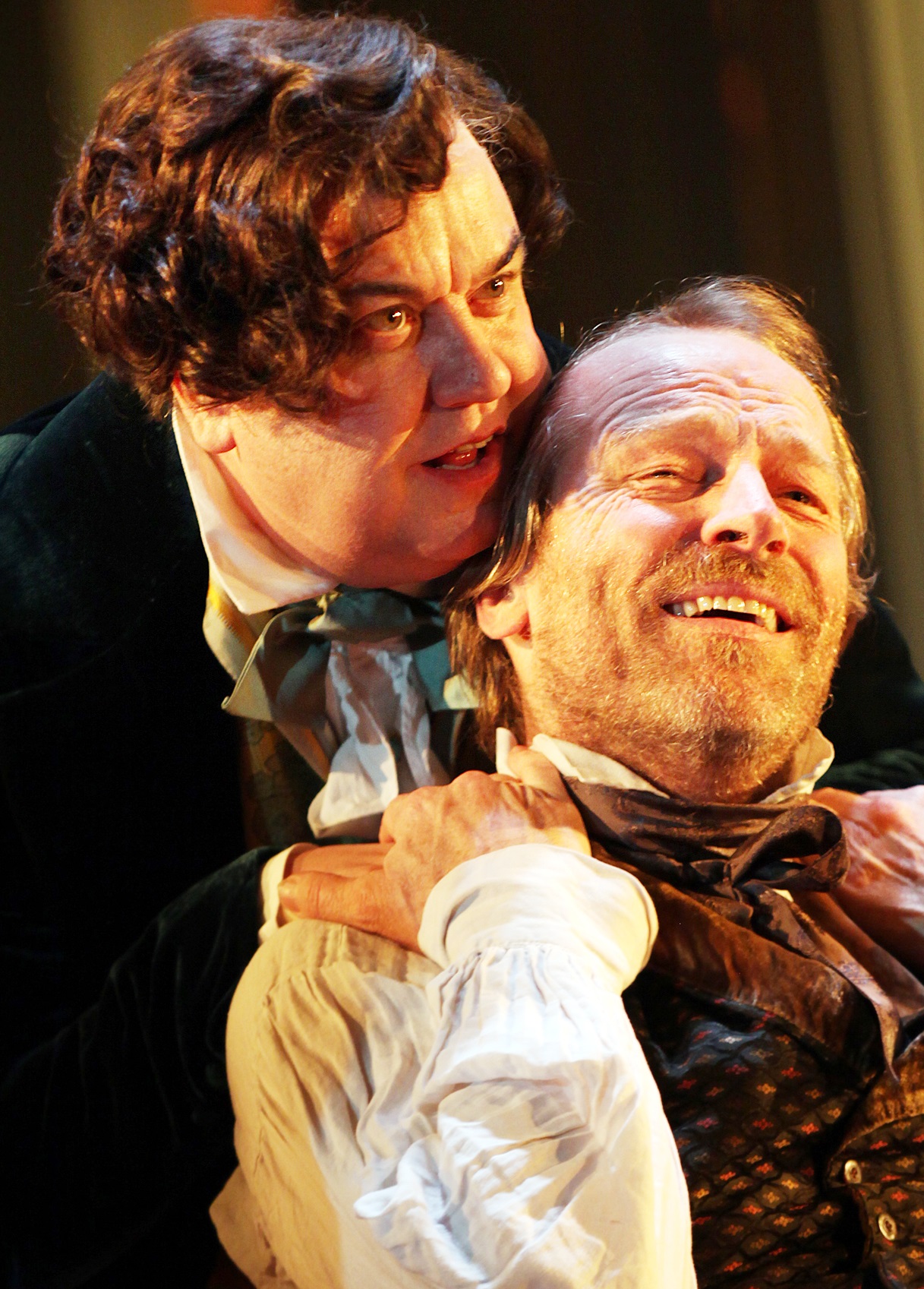
As they serve lunch to the assembled company, something rather devilish unravels – with hints of melodrama, there's no denying it. McCabe’s character makes sure Kuzovkin’s glass is refilled far too often (pictured above right, McCabe as Tropatchov, standing over Glen as Kuzovkin), forcing the latter to revelations he had never planned to make. Tropatchov is helped in the process by the pathetic but memorable attention of another sidekick, Karpatchov (Richard Henders), or “Karpie” as he’s patronisingly refered to by his master. Glen achieves lasting dignity in a searing reassertion of his true character the following day, developing from that reticent revelation in a way that will impact on the lives of all around him.
William Dudley’s design gives us a beautifully lit and luxurious country estate setting. If the production’s first half seemed a bit stilted, that may be something to do with the text itself – better known as a novelist, Turgenev, finally, is not the dramatist that his later admirer Chekhov would become – or it may play more smoothly as the production settles.
But Glen’s second-half revelations, played out in a heart-to-heart to Olga, do reach a Chekhovian intensity, as he recounts his past and present stories, trouncing in the process his opening adversary. McCabe may enjoy every last line of his smarmy and so very cruel character, and in his perorations dominates the stage. But Glen’s dignity as he makes his farewells overshadows all: he departs with that genuinely Chekhovian quality, nobility of character sustained in adversity.
- Fortune’s Fool at the Old Vic until 22 February 2014