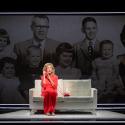
It seems appropriate that an onstage blender features amidst Tom Scutt's sleek, streamlined set for Julie given how many times Strindberg's 1888 play has been put through the artistic magimix. Rarely, however, have the results been less illuminating than in this National Theatre rewrite by Polly Stenham that replaces Strindberg's charged three-hander with a lazy recap of themes and situations Stenham has explored to far more rending effect elsewhere. Running shy of 90 minutes, Carrie Cracknell's production nonetheless feels as if it is struggling to fill time, due in no small measure to writing so attenuated that certain key relationships, even characters, seem barely to exist.
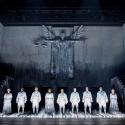
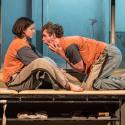
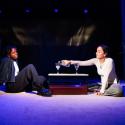
The setting here is no Swedish estate but a rectilinear, sterile-looking pile abutting Hampstead Heath which is in full-on rave mode (pictured below) as the play begins. At the centre of the frenzied vortex is Vanessa Kirby's febrile Julie, a character whom those acquainted with the Stenham canon will recognise from the off. Moneyed but unhappy and nursing numerous and lasting wounds (the painful death of a mother, for one), this Julie couples occasional gestures of kindness with a psychic distress that finds an outlet in Jean (Eric Kofi Abrefa), her father's hunky chauffeur.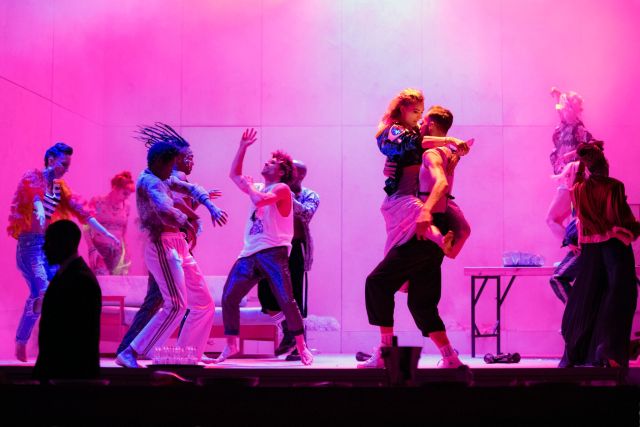 On site during the party to keep an eye on things, Jean has a partner of his own in the Brazilian Kristina (Thalissa Teixeira), who hardly figures within the narrative except to deliver a hectoring 11th-hour broadside at Julie, taking to task the hapless rich girl who has overstepped the mark. On the rebound from a birthday fete populated by people whom Julie scarcely appears to know (did she post the event on Facebook?), Julie pulls Jean towards her in more ways than one. Before long, the two are nursing the shared fantasy that they will hop a flight – paid for by her all-important if unseen daddy (here reported in a momentary burst of comedy not to be a Tory) – and start a new life together elsewhere.
That all comes before the harsh reality of Julie's pill-popping, coke-snorting existence snaps her back into the present and to a conclusion that must leave the gifted and tireless Kirby entirely wrung-out; would that it did the audience. A theatrical cousin of sorts to Cracknell's (superior) reimaginings of Medea (with Helen McCrory) and Nora (with Hattie Morahan), the title role here requires its leading actress to bottom out emotionally, and Kirby goes the distance with a commitment that makes one wish the Ivo van Hove-style chic surrounds in which she finds herself had more of real interest to say.
The result furthers Stenham's ongoing and clearly impassioned interest in abandonment as her landscape of choice but it doesn't expand in any meaningful way upon Strindberg's play, which seems doubly surprising given the careful choice to cast three principals across the ethnic and racial spectrum. Fine actors all, none of the three is allowed to develop to any significant degree, and the race card that might well be at play between Julie and Jean counts for little (and was played to far more probing effect by Yaël Farber in her career-defining Mies Julie not that long ago). Time and again, one waits in anticipation for scenes that haven't been written, only to find instead an overabundance of psychobabble (Julie feels like "the worst version of myself") to make one wonder whether this Hampstead denizen might be best advised to seek out a local shrink.
In the absence of much cumulative power, one is thrown back on details, not the least of which involves some surpassingly rude party-goers who leave without saying goodbye (as if!): on the other hand, given the disappearance of several of them via the innards of the kitchen cupboards, perhaps they're all training to be cat burglers, in which case good riddance. And it is surely notable that this property adjoining the open spaces of the Heath allows nary a trace of nature or greenery inside. Not for nothing by play's end does the modish decor come to resemble a mausoleum. The visuals are firmly in place in Julie; all that awaits is the play itself.
- Julie at the National Theatre to September 8; NT Live screening, September 6
- Read more theatre reviews on theartsdesk