Do you happily binge four hours of mind-candy TV in one sitting? Alecky Blythe’s latest verbatim play, Our Generation – which runs for 3hr 45min at the Dorfman space of the National Theatre – might take almost as long but will probably be much more rewarding.
Blythe made her name in 2011 with the excellent London Road, another NT production (staged by its current artistic director, Rufus Norris and subsequently filmed), which used as its script statements by people involved in events in Ipswich while a serial killer was on the loose. Most of the actors’ words were sung to simple tunes, almost like part songs. Intriguingly, these fragments of real lives cohered into a satisfying snapshot of a whole community. 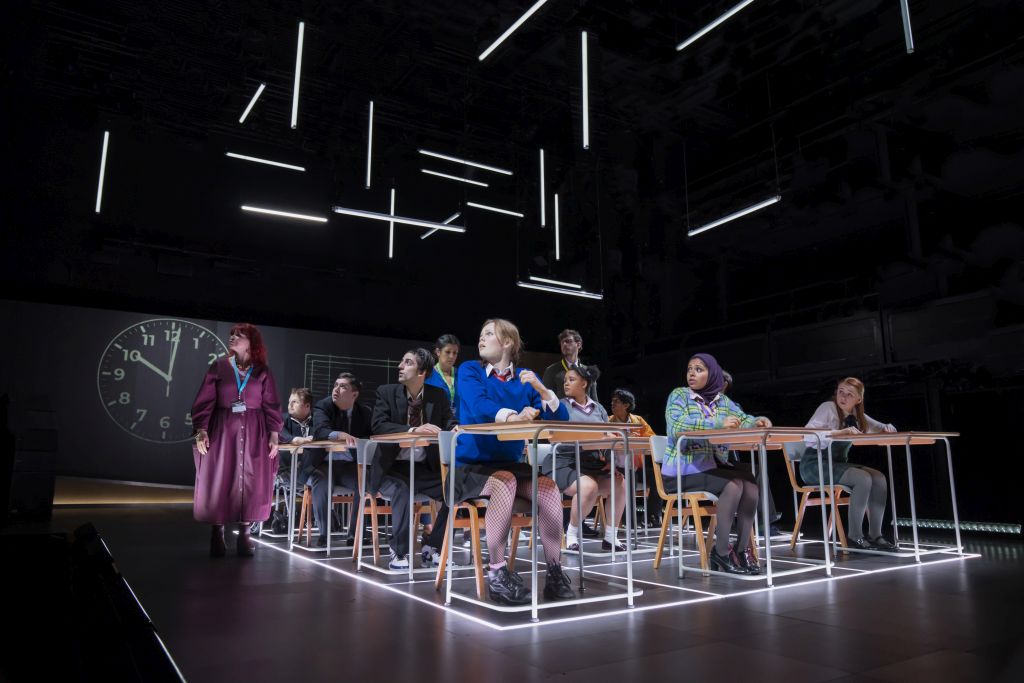 For her latest piece, Blythe has set out to capture a whole generation of teenagers. She recruited and trained five “collectors”, who for as many years recorded the thoughts of 12 teenagers from around the UK, from Belfast to Cambridgeshire and from all backgrounds. The group ended up with over 656 hours of material. The 12 young characters, aged 12 to 14 at the start, are ably played by actors about a decade older, supplemented by three even older actors as the various adults (parents, granny, teachers) in their lives. The teenagers emerge from this welter of collected words as clearly delineated personalities from the start. The fun is watching them grow up. (The ensemble, pictured above)
Of course, Blythe did not choose dullards as her subjects: the characters are natural comedians and all-too-happy performers – Luan, the beanpole basketball champ from Lambeth via Kosovo; Ayesha from Birmingham, who loves all things designer but ends up obsessed with Primark; her daffy older brother Ali, whose favourite topic is Kim Kardashian; Ierum, the sunny African girl aspiring to greater things, but what and how? One boy is a double amputee aiming for the 2020 Paralympics and a career as a PE teacher; another a jolly Thatcherite who wants to teach but can’t stand children and has to hide indoors when his face turns bright red from stress.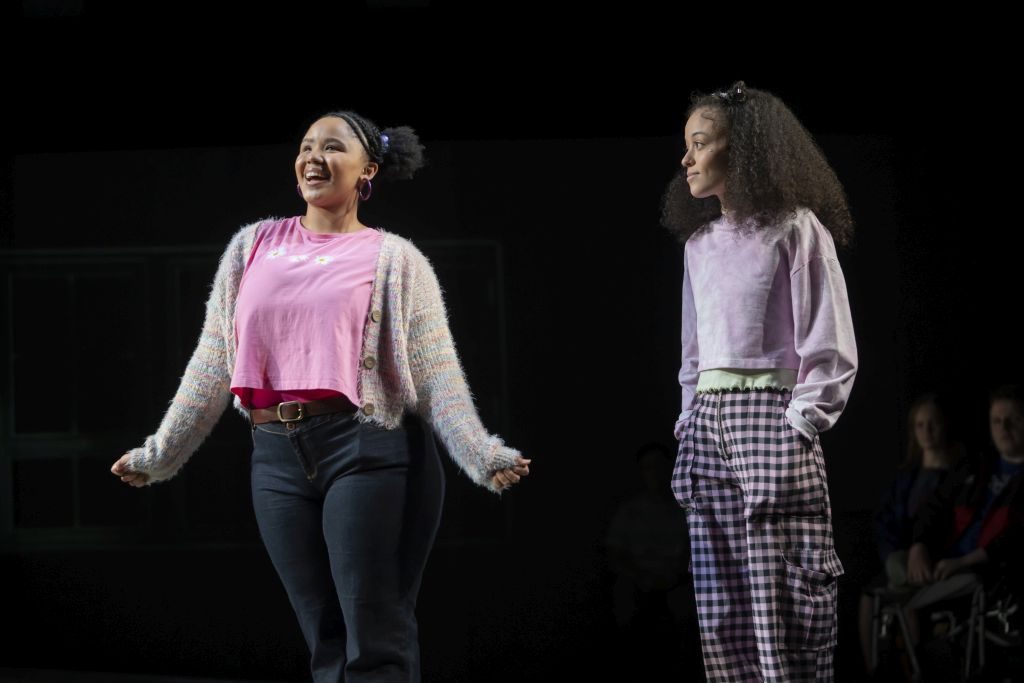 As their lives stutter on through school, sexual awakening and nonstop social media use, we see how their generation is both typically teenage yet unique in having even its tentative horizons blotted out by the pandemic. All share a dread of exams (except for posh Lucas, seemingly, for whom life is regularly “sweet”), an uncertainty about the future, an inevitable naivety about the ways of the world. Like teenagers from every era, they inhabit a world with its own parameters and argot – be prepared to understand why it really isn’t cool to break up with your girlfriend on Snapchat… Snapchat! And why “deep” doesn’t mean quite what you probably think it does. Phones dominate the landscape. When Ayesha is talking about death with her mother, it’s a phone image she turns to: that moment when your battery runs down and you lose all your mobile data.
Director Daniel Evans makes this mini-epic brim with the buoyancy and flair that have characterised his work over the years. It’s often laugh-out-loud funny – even to uncool adults, not just the teens in the audience (I suspect we weren’t always laughing at the same things). The cast studied the recordings their characters made so they could deliver not just their words but the exact sound of their speech, right down to the stutters and pauses. As a kind of acting, it’s eerie: you feel you are watching a doppelganger, not just an interpreter. It’s invidious to single out any of these impressive performers, but Rachelle Diedericks’s Ierum (pictured above, with Anna Jarrett), who opens and closes proceedings, is an especially welcome presence, with a lilting silvery voice and a consummate gift for comedy.
The set (design by Vicki Mortimer) is a black space with strips of white neon lighting overhead that, appropriately, form unfinished boxes. In one lovely scene, the characters are visible behind a scrim, onto which a video is projected that "draws" in their fears and fantasies over them. When they pull out the stops in the ensemble song-and-dance routines (impressive moves by Carrie-Anne Ingrouille), you don’t want them to stop.