Rock music helped to subvert the Soviet Union by glamorising youthful rebellion and the West. In the opening scene of Andrey Kurkov’s novel Jimi Hendrix Live in Lviv, a bunch of ageing hippies gather at night on the anniversary of the American guitarist’s death to pay homage to his “strange music that the regional Party committee didn’t understand, with its strange but, thank God, incomprehensible foreign lyrics”.
The unlikely venue for this reunion is Lviv’s Lychakiv cemetery owing to a Communist-era myth that the KGB had removed Hendrix’s hand from his body after burial in the United States and smuggled it to Ukraine where the relic was interred. Soon, however, proceedings are interrupted by an unexpected visitor, Captain Ryabtsev, a retired secret policeman who confesses that he spent much of the 1970s undercover spying on the city’s rock fans. He tells the hippies’ leader Alik, one of his former targets, that he ended up falling in love with the counterculture and with Hendrix’s music in particular: “He turned my life around. Thanks to him I lost all interest in my career.”
A rich source of urban myth, “one of the moist interesting and beautiful city-enigmas”, Lviv is the novel’s protagonist in many ways. Other equally fantastic plotlines unravel against the backdrop of its medieval streets. For instance, one of the main characters, Taras, makes a living as a “vibrotherapist”, treating Polish clients suffering from kidney stones by taking them on bumpy night-time rides up and down Lviv’s cobbled streets until the blockage miraculously extracts itself. Later he falls in love with a mysterious woman called Darka who works in a bureau de change wearing long green gloves because she is allergic to money.
Several residents of this landlocked city come under attack from shrieking sea gulls. Where could these marine birds have come from? One of the explanations for the “anomalous natural occurrence” seems to be that Lviv once existed underwater, and now the prehistoric Carpathian sea appears to be returning. “This, of course, resonates with the current situation in the country,” says Ryabtsev, “but I’m not talking about politics!”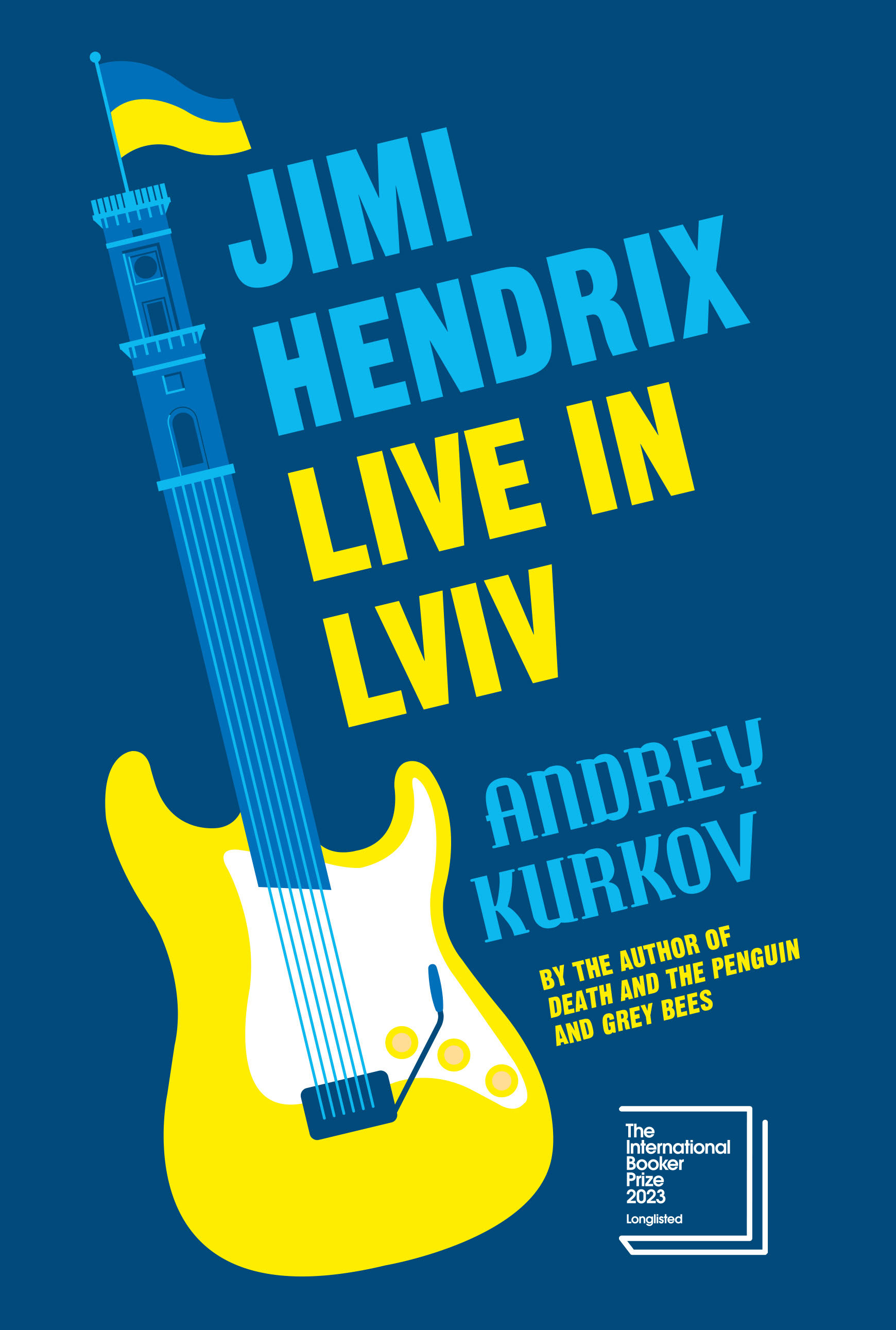 Comical realism with a twist of animal magic is characteristic of Kurkov, who is Ukraine’s most famous contemporary novelist. (He has been called “the Ukrainian Murakami”.) In his best-known work, Death and the Penguin (1996) a melancholy journalist adopts a king penguin from Kyiv Zoo. The hero of his 2018 novel, Grey Bees, is a lonely beekeeper abandoned in a village in the wartorn east of Ukraine after Russia’s annexation of Crimea nine years ago. However, Kurkov has stopped writing fiction since Putin launched his full-blown assault on Ukraine last year, and has turned his hand instead to vivid reportage with Diary of an Invasion (2022).
The past is a foreign country etc., but the various oddballs who inhabit Jimi Hendrix Live in Lviv, first published in 2012, seem to be living in what Kurkov calls a “double past”, in search not only of lost time but also of a vanished social geography. Unfortunately, as Taras acknowledges, “time can’t be rewound like a VHS tape,” and the Soviet culture of dissidence is just as obsolete. Reading the novel in Reuben Woolley’s elegant translation is to be aware of an obvious time lag since it predates the upheaval that has engulfed Ukraine since 24 February 2022, and even the earlier phase in Crimea and the Donbas. Its nostalgia reaches back to a happier yet still anomalous time, as one of the characters observes: “Happy people, while they’re happy, don’t notice anomalies, but that’s only temporary. The anomalies are always there!” – and Russian imperialism was always threatening to flood back like a mythical sea, or a burst dam, inundating Ukraine.
Kurkov explains in his acknowledgements that he was invited by the mayor of Lviv to write about this city straddling East and West, a place where doubleness is woven into the historical fabric as well as the nomenclature. Before it was Lviv – or Lvov, as it still is to Russian-speakers – it was Lwów, part of the Polish Republic, and before that it was Lemberg under the Austro-Hungarian empire.
Longlisted for the International Booker Prize, Jimi Hendrix Live in Lviv is a minor work by Kurkov’s standards, but its deadpan humour is anything but frivolous and his eye for detail is as sharp as ever, whether he is describing baroque architecture or spartan interiors, a clapped-out Opel Vectra or “shit-kicker boots”, a testament to the skill of Lviv’s shoemakers who were able “to bind the boot’s upper section tight to its lower counterpart, tighter than the Soviet government had ever quite managed, over almost fifty years, to bind Western Ukraine to the East.”
- Jimi Hendrix Live in Lviv by Andrey Kurkov, translated by Reuben Woolley (Maclehose Press, £16.99)
- More book reviews on theartsdesk