There are conductors, and then again there are choral conductors. I sang under David Willcocks in Tallis’s 40-part "Spem in alium" and remember vividly that long-armed semaphoring that he later applied so notably with the Bach Choir.
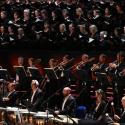
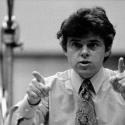
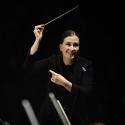
Sofi Jeannin, choral conductor par excellence (of, among others, the BBC Singers), is likewise a semaphorer, not always comfortable to watch, effective if not outstandingly individual in the outcome. In this typically hybrid BBC National Orchestra of Wales concert she conducted three tricky choral works with the dependable BBC National Chorus of Wales, and, sandwiched between them, the no less tricky Symphonies of Wind Instruments of Stravinsky and the perhaps marginally more straightforward Le tombeau de Couperin of Ravel. It was an evening of efficient, competent music-making, somewhat lacking in the heights and depths one hopes for in music of this kind.
The distinction emerged at the very start in Ravel’s L’Aurore, a five-minute choral piece about the dawn composed in 1905 for the Paris Conservatoire’s Prix de Rome. Like most Prix de Rome works (including Berlioz’s and Debussy’s various attempts), it’s profoundly, probably designedly dull music, if showily written, with colourful orchestration and rich textures. But one listens in vain for any anticipation of the famous, supremely un-dull dawn music in Daphnis et Chloë, six or seven years later. Likewise in the incessant fake orientalism of Lili Boulanger’s Vieille prière bouddhique, one searched in vain for traces of the brilliance of her best choral music (Du fond de l’abime, for instance). Even women, it appears, are capable of writing bad music. But Lili needs no apology, except perhaps from God for taking her when she was only 24. 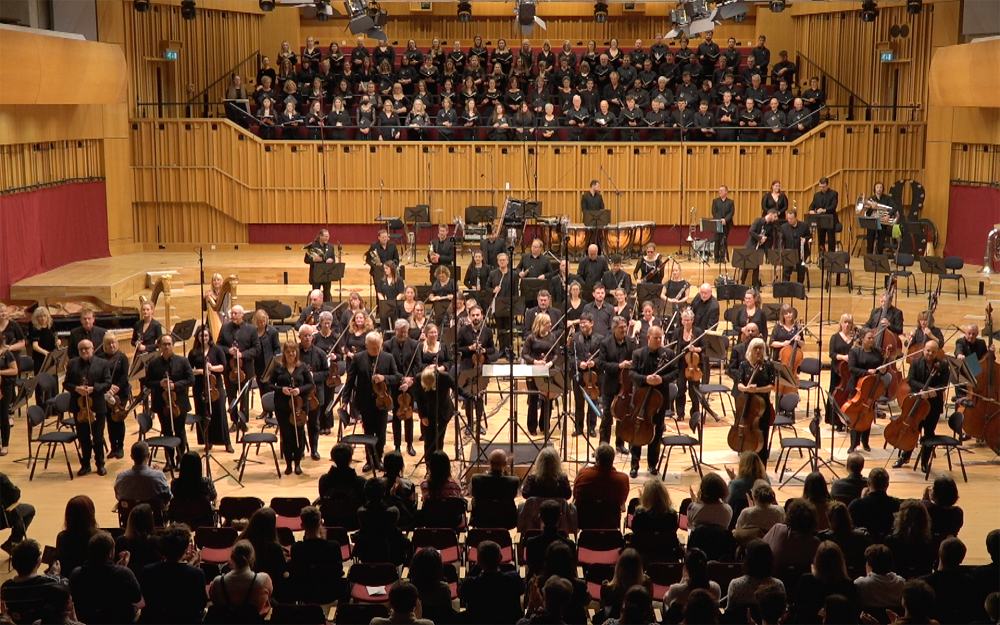 Jeannin could make little of this unpromising material, but managed it attentively and respectfully, qualities she also brought, at the end of the evening, to Stravinsky’s Symphony of Psalms. This was a solid, correct performance, well-paced, slowish speeds that in fact agreed with the revised score, though Stravinsky was wildly inconsistent in these matters and often seems not to have noticed the big tempo changes he made in otherwise unaltered revisions. What Jeannin didn’t always achieve was that particular incisiveness the composer calls for in the articulation of consonants and syllables. For him, words were often not meanings but sonorities. And I missed in Jeannin’s reading this spitting of the syllables, in for instance the soft Laudate dominums of the finale – a technique hard to achieve with chorus singers who tend to think in terms of line rather than the old lips, teeth and tongue.
Much crisper was Jeannin’s take on Symphonies, also in the comprehensively revised score of 1947. Like Koussevitsky in the notorious London premiere of 1921 (with a Brahms symphony), she left the wind players where they had just been for Ravel, with the heavy brass away to the right, which raised some issues of blend and balance while requiring the conductor to continue semaphoring. Only in Le tombeau de Couperin, with its standard Mozart orchestra plus a single trumpet lurking shyly beside the bassoons, was she relieved of this necessity, and to tell the truth this was the most enjoyable, relaxed performance of the evening, with some lovely woodwind playing especially, but the BBC NOW generally in finely polished form, and Ravel, of course, at his elegant best.