There were a lot of horns on display in the BBC NOW’s latest concert in Cardiff’s Hoddinott Hall. Brahms’s Second Symphony has four of them, and so does the Elegy for Brahms that Parry wrote on hearing of Brahms’s death in 1897. Gavin Higgins’s Horn Concerto, whose world premiere formed the programme’s centrepiece, has no less than five.
It was a horny concert, in the nicest sense, but even in that other sense that nice people don’t mention, such is Brahms at his most – shall we say – virile.
Higgins is himself a horn-player, so his concerto is not just a passing commission but clearly something more quintessential, even existential, for him. It starts with the four orchestral horns growling on low E flat arpeggios like the ones that open Wagner’s Rheingold, and later in the first movement (of three) the horns dialogue with the soloist, a moving and witty touch, like listening to the owls that signal to one another outside my house in Herefordshire.
Higgins himself comes from the nearby Forest of Dean and for him the image of his concerto is not watery but arboreal. He has perhaps been reading Merlin Sheldrake or Peter Wohlleben on the Wood Wide Web, but though he calls his movements “Understorey”, “Overstorey” and “Mycelium Rondo”, the music works on its own terms, not by association. The form is strongly braced over its half-hour or so; Higgins has an ear for harmony that enables him to enrich tonal thinking with dense chordings that certainly are a bit like undergrowth, but without ever losing his way. And the music seems thought through in thematic terms. Its ideas are distinctive, and recurrent.
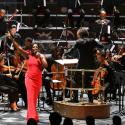
But it’s the orchestral colouring that sticks most in the memory: the piccolo duet that opens the second movement, as high as the horns were low; the fluttering strings in the helter-skelter finale, a sound one is conscious of without at first being able to locate; the pitter-pattering xylophone (wood, naturally); and of course the spectacular horn-writing, reminiscent now and then of Strauss or the Britten of the Serenade, but wider ranging and more ambitious. Ben Goldscheider (pictured below) seemed untroubled by these demands, which included athletic trips through the registers, rapid changes of mute, and none of the cracks and blahts that usually punctuate even the best horn-playing and are, of course, always the instrument’s fault. It was a superb display.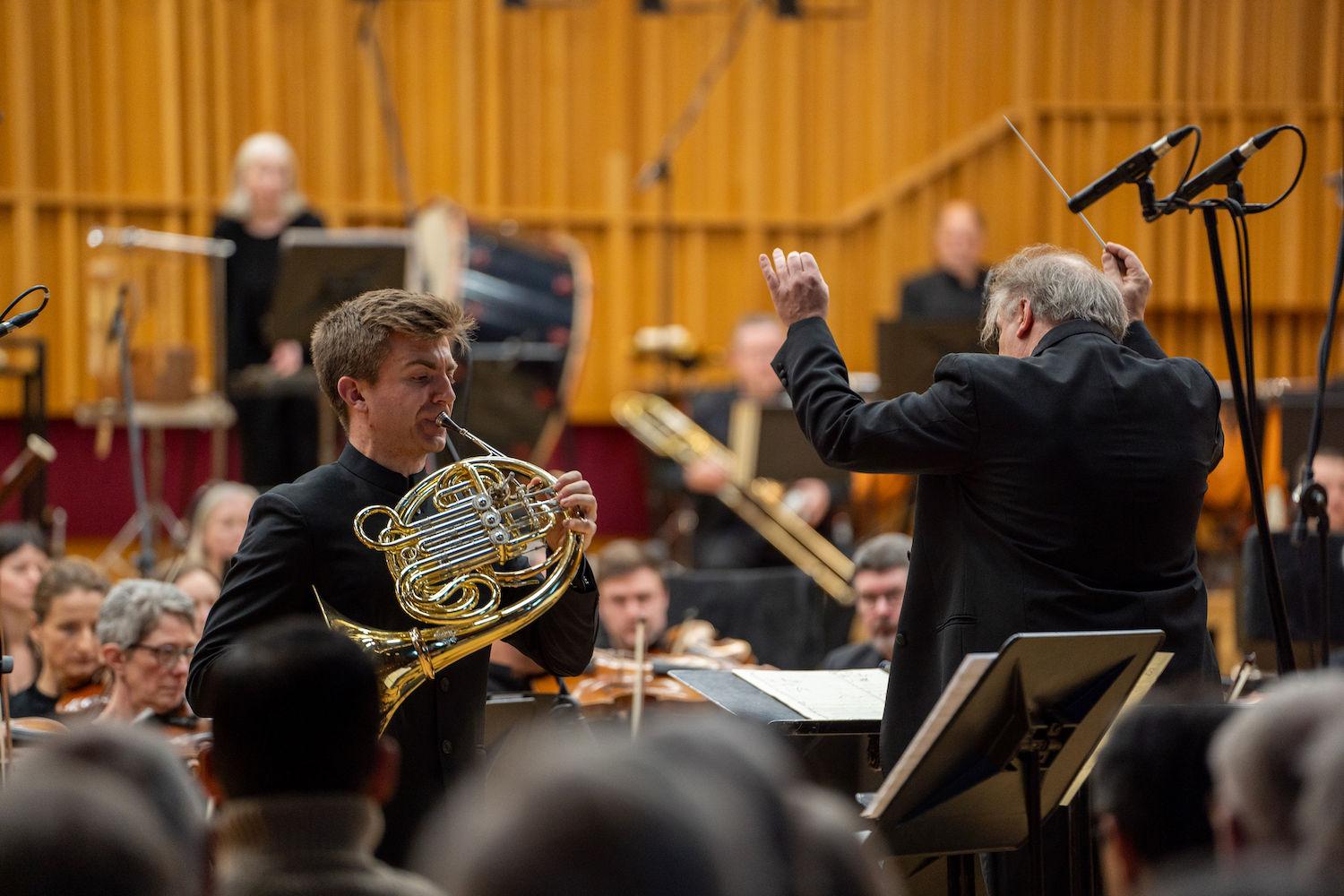 Jaime Martin drew powerful and utterly committed playing from the BBC NOW, and it seemed to reverberate into the Brahms symphony after the interval, a performance of positively blistering vehemence that completely contradicted the usual image of this work as a relaxation after the stresses and strains of the C minor Symphony just before. Brahms, like Higgins (and Wagner), starts with horn arpeggios, written in his case for the natural instrument (without valves), but drawing on a generalised image of the horn that has stuck, though technically no longer necessary. This is another aspect of the essential character of Higgins’s concerto; his horn can play what it likes, but is drawn to its historic character which is then stretched into new shapes.
Parry’s Elegy for Brahms mainly declines to be limited in this way, and is in fact a big, almost 15-minute piece for large orchestra, mostly more Wagnerian than Brahmsian, though now and then breaking into limpid melody in woodwind colourings that recall the Master of the D major Symphony. Oddly, Parry never finished the work, which was completed by Stanford and played in 1918 as a memorial to its composer. So elegies, like noses (and horns), turn out to be hereditary.
This memorable concert was recorded for future broadcast on Radio 3. Look out for it.