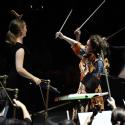
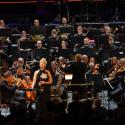
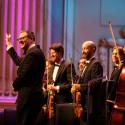
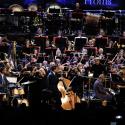
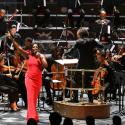
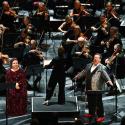
If much of the Austro-German repertoire is about hiking to a spiritual peak, the Franco-Spanish is about diving down to the orchestral depths. The music of Ravel, Debussy and Falla has beefy shoulders and powerful legs. But the vast watery expanse of the Royal Albert Hall is hard-going even for these expert paddlers. I've never seen anything by these composers that hasn't drowned in this space. So I came to last night's concert hoping that the BBC Philharmonic's new Spanish conductor, Juanjo Mena (he takes over officially next season), would show us all how to ride out these waters.
He certainly tried. Mena's tack seemed to rely on avoiding direct confrontation with the beast surrounding him and instead trying to refine and reduce his orchestra's sound in order, almost, to hide. He was like a cowardly toreador, dressed to dazzle but always dancing around the edge. We tiptoed through the music, elegantly but dispassionately. All of which meant that the virtuosity was being demanded of us and our ears.
Once properly focused, what one heard was often rather alluring. The timpani rolls in Ravel's Rapsodie Espagnole or the trumpet flutter-tonguing in Alborada del gracioso whipcracked the BBC Philharmonic into small frothy waves. Sultry passages were indulged. Wind was allowed to tumble through the textures. Echoless percussion desiccated the air. There was a lot of intermittent, isolated interest. But not enough of it was properly casting a spell. However attractive some of the playing was, one couldn't escape the feeling that these musicians were behaving more like tourists than natives.
The Ravel fared better than the Debussy. His Images were all too shy or sozzled. We needed more focused passion, more macho swagger and less coy hiding behind fluttery fans. The muscle might have come in the brawny Falla piano concerto, Nights in the Gardens of Spain, which saw the appearance of Steven Osborne, a bit of a go-to pianist for this repertoire. The orchestra certainly did man-up in their passive aggressive unisons. But Osborne rarely joined them. He seemed to be on a mission to keep cool, calm and sober, revelling in such a sun-creamed sound that it made Mena look like Don Quixote. The result wasn't pretty. Royal Albert Hall: six; Franco-Spanish music: nil.