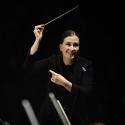
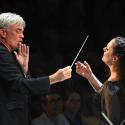
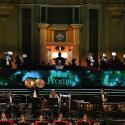
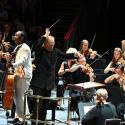
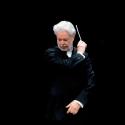
You can't say this about many works but Verdi's Requiem really is as snug as a bug in a rug in the Royal Albert Hall. In which other space could the three moon-like bass drums orbiting the back of the orchestra not look ridiculous? Last night's performance seemed to have all the hallmarks of a classic. Great cast. Three of Britain's great amateur choirs. One of the most talented conductors of his generation. All Bychkov needed to do was mix and stir. Right?
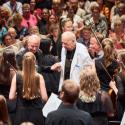
Certainly if we went around individually, no fault would be found. The choir (which included the BBC Symphony Chorus, BBC National Chorus Orchestra of Wales and London Philharmonic Choir) paraded their flawlessness first. Their dramatic, early, washed-out sound exploded with unforgettable terror in the Dies irae. And what an unbelievably well-drilled lot they were, tackling the fugal Sanctus as if they were a hundredth of the size. They were characterful, united and yet somehow alert to every nuance of the words. There was fear and grisly excitement in their reporting of the details of the day of judgment, cold sweaty-palmed mania in their evocation of eternal rest.
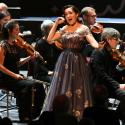
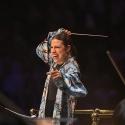
Marina Poplavskaya (pictured below) was the first of the singers to impress. She apparently had a cold. There was little sign of it. But she did play the role of the praying supplicant with such fervour that I did wonder if there was something niggling at her that was making her inhabit the God-cooing role so conscientiously. Mezzo Mariana Pentcheva opened with a vibrato that oscillated so broadly it sounded like she was yodelling. But she tightened up at the top for the Lux aeterna.
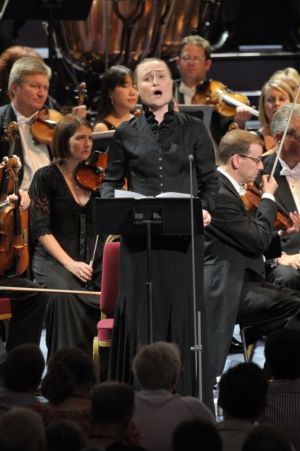 Ferruccio Furlanetto's roomy bass and Joseph Calleja's seductive tenor were, as ever, both seriously classy. They might have (and, now and again, did) introduce a sense of theatre to this operatic requiem. The orchestra might have followed the choir's lead and played with a touch more colour. But Bychkov appeared less interested in the short-term roller-coastering peaks and troughs than the long-term restless search for spiritual respite.
This focus on structure meant that the final 20 minutes saw the most memorable playing and singing. A frailty hit Poplavskaya's voice in the Libera me that elicited the most tender singing imaginable. While others sang with fluency, Poplavskaya inhabited the heart and soul of a whole other character, a whole other spiritual domain. With Bychkov, heart and soul came with the earth-shattering final choral climax. This was the point the desperation of this atheist's requiem really seized me.
Having said all this, I must confess, somewhat shame-facedly, that I feel I might be falling out of love with this piece; for the first time in my life, I could only see gaucheness in the score. And its theatricality seemed to say little to the tragedy of Saturday. Yet Bychkov rescued it. His sober but ultimately bone-shakingly cathartic take made one realise how much can be gained from viewing Verdi's creation sombrely, seriously and in a single cosmic span.
- Listen again for the next seven days on the BBC iPlayer via the Proms website
- theartsdesk's pick of the Proms
- theartsdesk's BBC Proms 2011 complete listings