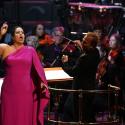
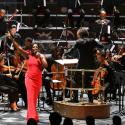
“I need to get a new gimmick.” Joyce DiDonato hobbled her way onto Milton Court’s stage last night, warning her audience to expect a seated performance owing to a sprained ankle. It was just six years ago she famously broke her leg during a performance of Rossini’s Il Barbiere at Covent Garden, but now, as then, she continued with no obvious dimming of intensity or focus.
DiDonato was joined by composer Jake Heggie (turned pianist, here) and the Brentano Quartet for the first concert in this final leg of her Artist Residency at the Barbican. Today she’ll deliver a masterclass to Guildhall students and Friday night’s finale sees her join forces with the New York Philharmonic, but last night’s recital was a more intimate – possibly more interesting – affair, built around the European premiere of Heggie’s song-cycle Camille Claudel: Into the Fire, composed for DiDonato.
Heggie is more pretty Renoir than form-breaking Monet
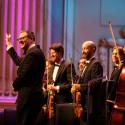
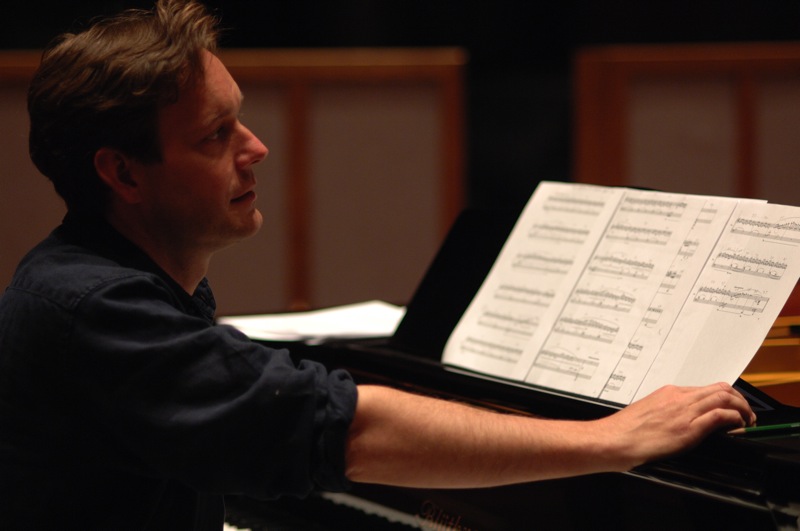
Heggie (pictured below), best-known for his operas including the shattering Dead Man Walking and Moby Dick, has a musical instinct that cannot help but resolve into melody, and this song-cycle is no exception. Steeped in Claudel’s world of the Parisian Belle Époque, the string quartet create a halo of pointillist colour around the thick, assertive brushwork of the vocal line. Claudel’s life was a turbulent and tragic one. Rodin’s pupil, mistress, muse, the sculptress ended her life all but cast off by him, abandoned in an insane asylum. Her life is recounted here in a series of emotional snapshots – poems by Gene Scheer, each inspired by one of Claudel’s sculptures.
 The verse is charged – a little too charged, perhaps, for the simplicity of its poetic forms – lending a slightly sophomore tone to music that deserves better. Yes, Heggie is more pretty Renoir than form-breaking Monet, but there’s something direct and rhetorical in his writing here that transforms what could easily remain sophisticated musical pastiche (the Debussy string quartet lurks in the background of almost every bar) into something more organic.
“Shakuntula” keens with sensual urgency while “La petite chatelaine” finds something lacking in the frankly sentimental verse, supplementing it with a classic Heggie melody – a cantilena that unfolds with beautiful inevitability. The cycle closes with a musical portrait of madness – a quiet, dignified madness, that only occasionally breaks out into the open: “Here they are trying to poison me. (I see that they don’t. I cook for myself.)” Memories and echoes drift in and out of the music, fragments caught momentarily by the voice, before they evanesce.
Take away her voice and DiDonato would still be an extraordinary performer. There’s a musical theatre quality to Heggie’s writing that shows the mezzo at her best, allowing her to release the full force of her dramatic and vocal energy, successfully redirected into comic asides and wry observations earlier in the evening in Reynaldo Hahn’s Venezia.
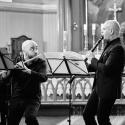
Bridging the gap between Hahn’s gorgeously disposable musical postcards and the confessional Heggie was Debussy’s String Quartet. The Brentano Quartet have a woody blend, a mistiness to their sound that makes absolute sense of the Andantino, though occasionally I longed for more brilliance and bite in the outer movements, providing the acid colours to temper the even umbers that come so naturally to them – extremes needed particularly to animate the mercurial moods of the fourth movement.
Taken as a whole, this was a tremendously satisfying evening of music – a programme that looked fragmented on the page, but which came together in performance, thanks largely to the driving conviction of DiDonato. An arrangement of one of Strauss's best-loved songs, “Morgen”, brought all musicians together for a surprise end to the concert, offering all the transcendence and benediction the Heggie couldn’t without betraying its subject.