Scotland’s East Neuk is a little like Hardy’s Wessex – less a geographical specific and more an idea, a resonance. Tucked up into the crook of the Firth of Forth, directly below St Andrews, the region encompasses the tiny coastal towns of Crail, Pittenweem, Anstruther and St Monans, where stern stone cottages and still sterner churches have done battle with the elements since at least the 9th century. But while there’s plenty of ancient history here, a visit each July will find it defiantly in dialogue with the present, as local churches, gardens and even a potato barn are taken over by the sounds of the East Neuk Festival.
Founded in 2005, the festival has always maintained an eclectic mixture of musics, but contemporary works have remained a constant. Last weekend however saw East Neuk’s most ambitious project to date. Inspired by Adams’ home landscape of Alaska and conceived for outdoor performance, John Luther Adams’ Inuksuit is more sound installation than a piece in the conventional sense. Any work for which the use of “GPS units”, “topographic maps” and “tents” is potentially advised leaves little doubt of its progressive credentials. In its Scottish iteration however no tents were required, with the performance framed in the glorious walled garden (pictured below right) of East Neuk’s Cambo Estate.
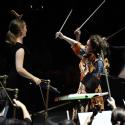
 Thirty percussionists sprouted from borders, stood framed in willow branches and were dispersed across lawns. The audience were encouraged to wander, chasing sounds as we wished, or simply sitting down and letting them fan out around us. In practice most of us did both, lulled into stillness by the work’s contemplative outer sections, but stirred into movement by its central animation – fulfilling Adams’ own creative vision of spatial and sonic blurring.
Enacting “a single breath”, the work grows out of husky, unpitched breathings, the gentlest of blowings into man-made tubes that duetted here with the gulps of the stream, before growing into percussive violence as sirens and bullroarers give voice. It’s confrontingly primal, with instruments often establishing tense duets and trios, batting sounds to and fro across the space in combative style. But for all the score’s inherent freedoms, there’s nothing anarchic about Inuksuit. Perhaps this was the careful direction of Bang On A Can’s Steve Schick (who has a long and intimate association with the work), but the generous abstraction of the concept invites listeners to fill it with narrative, while keeping the musical structure simple enough to act as scaffolding to any number of stories.
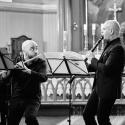
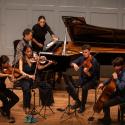
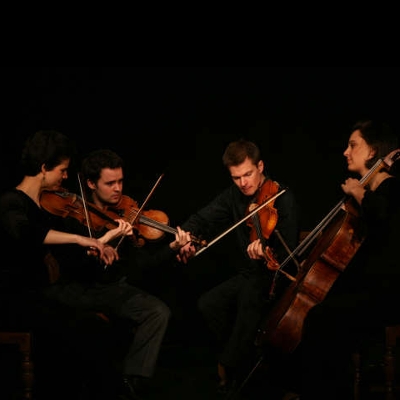 At the other musical extreme from Adams’ experimentalism, East Neuk also offers a programme of core chamber works. One ensemble who have been regular visitors to the festival (and will return again next year) are the Elias Quartet (pictured left), whose first of two concerts paired Schumann’s Quartet No. 1 Op. 41 with Beethoven’s No. 13 in B-flat major, Op. 130.
Former Radio 3 New Generation Artists, the quartet have been quietly establishing themselves among the UK’s leading young ensembles over the past few years and are currently working on an extended Beethoven project. But before the meat of the Beethoven with its mighty Grosse Fugure finale, we opened with Webern’s emotive miniature Langsamer satz. The quartet’s blend lent burnished unanimity to the opening, never over-complicating the musical sincerity. Yet for all their accomplished simplicity, doing less so elegantly where more might have been the easy option, they didn’t quite find the strength to force the moment to its crisis, to follow Webern into his youthful extremity of emotion.
Any doubts though found little foothold in the Beethoven – calibrated minutely to allow for the weightier finale, building from the throwaway wit and ebullience of the Presto into a measured Andante before stripping all right back (our resistance too) for the Cavatina, flaying us bare in preparation for the fugue. Here, only a slightly underweighted viola, blurred a serious climax, showcasing the quartet’s technical abilities but also their expressive control, never allowing the beast to dominate them and their interpretative choices.