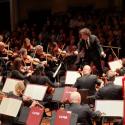
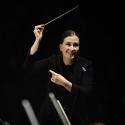
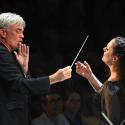
With a trio of easy-on-the-ear 20th-century works, Thomas Søndergård marked his debut with the London Philharmonic Orchestra. A pleasingly full crowd took the opportunity to hear the work of a conductor rarely glimpsed in these parts outside the BBC Proms. His appearances there in charge of the BBC National Orchestra of Wales have given the impression of a contented, highly competent musician, at ease both with the players before him and the scores on the music stand.
Whatever that summary leaves out was also missing on this occasion. However new, unfamiliar or classic the repertoire, a performance under Søndergård tends to be persuasive without having anything particular to say. So it was with the opening suite from Sibelius’s music to King Christian II. Five movements set the scene both for a bloodthirsty history play and the unfolding novel of his symphonies, of which he was brewing ideas for the opening chapter when he fulfilled this handy commission early in 1898.
The performance gained conviction and authority as it went along There are timps let loose from a subsidiary role of orchestral punctuation, long string threnodies, incisive brass interruptions to the meat of the argument delivered by chirruping, insistent winds like a dawn chorus on crack. All the elements are there for a roistering piece of early Sibelius after the fashion of En Saga, but they don’t add up. The suite concludes with a busily long-winded Ballade to accompany a scene in which the king had most of his enemies beheaded at a banquet. Søndergård brought it off with some panache, but ‘Stockholm Bloodbath’ it was not. Scuffle in Surbiton, more like.
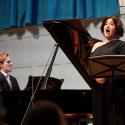
With Yehudi Menuhin in mind, the Violin Concerto by Andrej Panufnik was evidently written for an old-school violinist with Bartók and Prokofiev under his fingers. Sergei Krylov (pictured below right) turned on the megawatt Russian tone to reach the back rows of the Festival Hall in the opening Rubato and projected an angst-laden cantabile line to intense if unvaried effect in the overlong central Adagio. The concerto’s most original music is saved for a series of accelerating recitatives in the finale. Panufnik’s compatriot Lutoslawski would later take a similar idea and fill it with subversive energy; the concerto returns to spick-and-span bustle with a pay-off to keep the punters happy.
 Composing new music for people who don’t much like it was one of Shostakovich’s main concerns while writing the Fifth Symphony. His head was on the block after Stalin took exception to the sex, violence and brass bands in his Lady Macbeth opera, and he needed a feelgood symphony to clear his name. The massive and dissonant Fourth certainly wouldn’t do, so he stuck it in the bottom drawer and quickly came up with a new Russian epic in the tradition of Tchaikovsky’s plucking triumph from the jaws of disaster. Ubiquitous until a decade ago, when the Tenth began to displace it from touring schedules, the Fifth is still standard stuff for most orchestral players, which is why some moments of uncertainty and slips of ensemble during the opening movement were unexpected.
No matter – the performance gained conviction and authority as it went along. Søndergård built the Largo with patience and gathered forces of concentration around him, before picking a judicious path through the controversy-littered finale. Arguments over the composer’s memoirs and metronome marks have been so done to death that the symphony’s conclusion may have lost forever whatever original meaning it had. With Søndergård holding the pulse on a tight rein but not throttling it to death, the final blaze was dispatched with grim defiance.