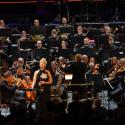
Roger Wright may be gone from the BBC Proms, replaced for now by a committee, but his legacy lives on. His zeal to recover areas of English musical culture that may be considered the festival’s birthright resulted last night in a first Proms performance of Sancta Civitas, which Vaughan Williams late in life accounted the favourite of his choral works.
Not so much unperformable as unprogrammable, Sancta Civitas (1923-5) requires forces hardly shy of Mahler’s Eighth Symphony, yet lasts barely half an hour – or a little longer than that in this solemnly monumental if well-prepared performance, but reasons for its neglect may lie more in its theme and tone. To many modern ears, the title is sententious, the notion of a Holy City absurd, even dangerous, even when cloaked in the composer’s pastoral vein of moderato, major-key contentment.
Look and listen more closely, however, and the piece is extraordinary, and weird, and presents no less unsettled a vision than the orchestrally worked-up The Lark Ascending (1921) and the "Pastoral" Symphony (1922) which directly preceded it. The text, chosen from various translations of the Book of Revelation, rejects earthly corruption for a Utopia which places the work within a strain of English Socialism running from William Morris through to Ealing Comedy: imagined by a self-confessed agnostic, this New Jerusalem is less doctrinally Christian than The Shape of Things to Come (HG Wells was another friend and associate through the composer’s long life), though clearly also owing much to Vaughan Williams’s obsession with The Pilgrim’s Progress, which he laboured to set for over four decades.
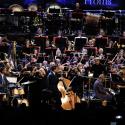
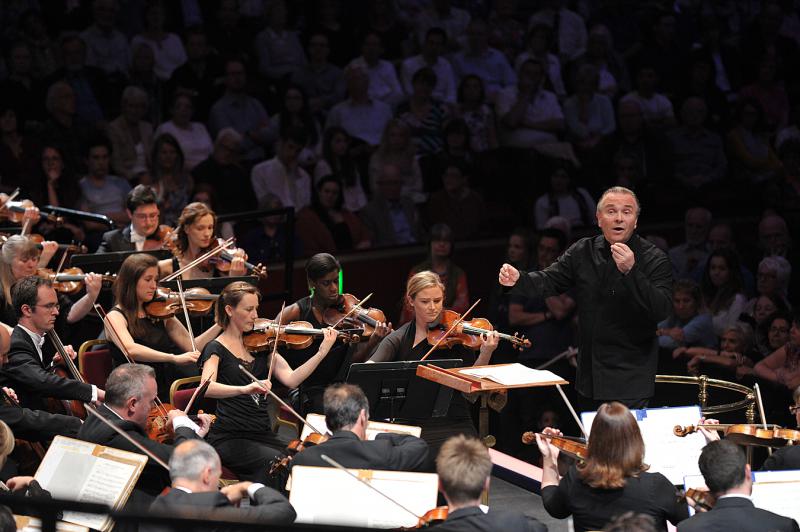 Sancta Civitas has no tunes as such. Instead it revolves around no more than a couple of musical ideas. A sequence of dissonant chords heard at the opening, close and often in between, is scored for three flutes and bass, while all other voices and instruments lie silent. Their full weight is reserved for one stupendous climax, a real "Take me away" moment (Elgar also admired the work greatly). Trinity Boys’ Choir were full-throated angels in the gallery, often (too often) heralded by a solo trumpet. Iain Paterson was a gruffly resonant Evangelist for the first 10 minutes, then Robin Tritschler was aptly clarion-voiced for his two phrases in the epilogue.
The close of the Adagio was pure, grim PathétiqueMuch of the rest is choral recitative, sung on the night with impressive warmth and discipline by the Hallé Choir, Hallé Youth Choir and London Philharmonic Choir, which Sir Mark Elder could have done more to shape flexibly and impulsively: the piece is not as crotchet-crotchet-minim, molto moderato, Anglican anthem as he made it sound. The turning point of Sancta civitas comes with a setting of "Babylon is fallen" as a subdued lament for debased humanity (imagine what Walton would have done: hire another brass band, probably), which quietly cedes to an ecstatic violin solo (the excellent Lyn Fletcher) pointing the way, Lark-like, towards "a new heav’n and a new earth".
The work must have taken the meat of available rehearsal time, and rightly so. The Prom began with a turgid account of Debussy’s Prelude à l’aprés-midi d’un faune with an over-blown, vibrato-heavy flute solo. After the interval, Elgar’s Second Symphony had its moments, notably those where Elder uncovered the work’s roots in Mendelssohn (the Scherzo) and Tchaikovsky (the close of the Adagio was pure, grim Pathétique). Elsewhere, some tired playing, conservative tempi and Elder’s smoothed-over approach to the quasi-Expressionist contrasts of the outer movements combined to muted rather than specifically elegiac effect.