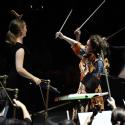
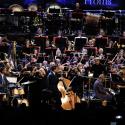
“That,” she said, “is what it must be like when you enter heaven.” And I knew just what my wife meant. The organ was in full regalia, revelling in the marshmallow glory of the chorale theme in Saint-Saëns’ Third Symphony, with the orchestra trumpeting behind. The Royal Albert Hall itself proved pretty impressive, even when the gentleman in the row in front spent most of Franck’s Symphonic Variations eating a tub of ice cream. It was that kind of Friday night, with a packed and enthusiastic audience ready to enjoy everything that the BBC Philharmonic and their Conductor Laureate, Gianandrea Noseda, put before them.
Well, almost everything. You couldn’t say that volleys of applause followed Noseda’s first offering – the long-delayed Proms premiere of Alfredo Casella’s Elegia eroica, an abrasive, shape-shifting memorial to the Italian dead of the First World War, composed in 1916. But it was still a fascinating 15 minutes, twisting kaleidoscopically from its ominous opening of dissonant horns, snarling timpani and aggressively trilling strings to the consoling coda with celesta and solo flute. One of Noseda’s missions in life has been to widen the world’s knowledge of Italian composers of the 20th century (early to mid), and his old orchestra piled into this colourful chunk of the protean Casella with admirable verve and dedication.
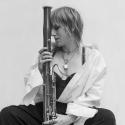
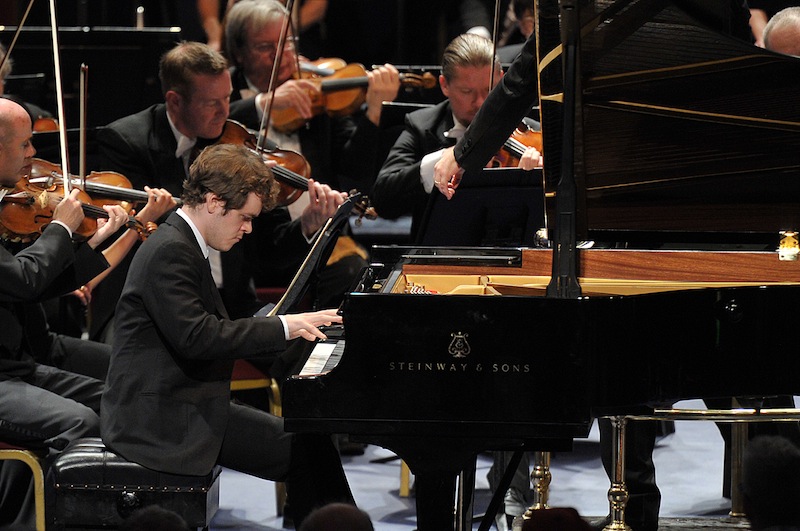 The colours indeed were so bold and startling that they made the introductory textures of Chopin’s First Piano Concerto sound more than usually drab. No one goes to Chopin for orchestral sparkle, but should we have had this much mud to wade through? Still, we had Benjamin Grosvenor’s fingers (the pianist pictured above) to look forward to, the fingers of Britain’s golden boy, now all of 22, so often such a poetic performer.
Though somehow not always in Chopin, a composer who’s caused him in the past to skate around beautifully (oh, those filigree decorations) without ever quite reaching the music’s soul. And so it was here. Head soberly regarding the keys, his fingering always stayed elegantly tidy and his tone clean. But the piano playing seemed too tightly tailored to reach far across the Royal Albert Hall, even when Noseda’s arms gave their customary impression of planes coming into land. The audience positively bathed Grosvenor in hot applause, though one wonders if some weren’t applauding his fame and age rather than his actual performance.
Happily, Grosvenor communicated more emotion and pleasure when playing the wriggling caterpillar that is Franck’s Symphonic Variations. Franck is a composer who usually gives me an upset stomach, but even that didn’t stop me appreciating the virtuoso diamonds Grosvenor scattered among the theme mutations and rippling harmonies. Even better were those moments when the pace slowed and textures thinned to the piano’s solo line, each sound poetically shaped. You could hear the hall hanging on every note. Here, the applause was justified.
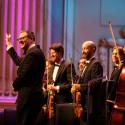
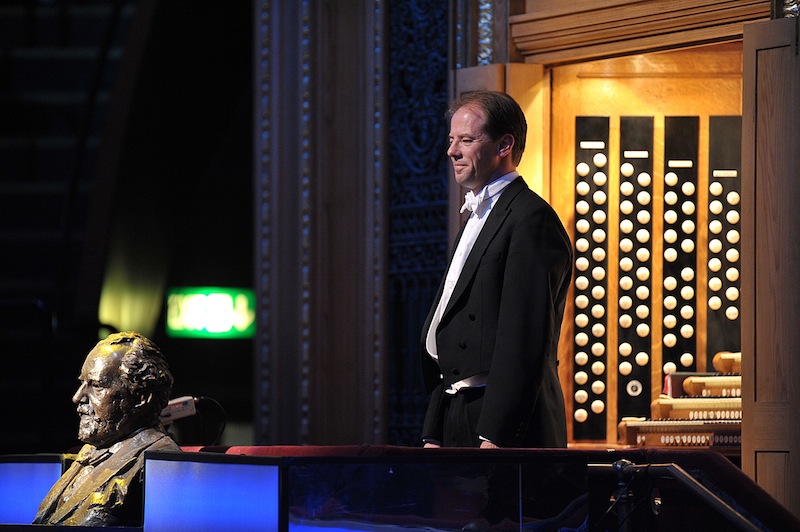 After that, the marshmallow, with David Goode at the organ (pictured left). It’s easy to see why Saint-Saëns’ “Organ” Symphony has bucked its nay-sayers and become so popular. Its use in the estimable film Babe has helped, along with the recent flourish of performances using newly restored British organs, like the grand beast at the Royal Albert Hall.
Above all, there are the work’s core strengths: its memorable tunes, its structural subtleties, and fine contrasts between rapturous clamour and quieter moments of dancing clarity and surprise. The sound balance of this performance was just right, with the organ something to relish even when serving as a taste of honey or a gentle embrace. Noseda and the Philharmonic had their glories too as the orchestra delicately fragmented to reveal four hands at a piano tinkling alongside singing strings. At such moments there was only one word for it: heavenly.