I was in Germany last week, and nearly every town I went to was advertising a St Matthew or a St John Passion taking place in the week up to Easter. It says something about how deeply engrained Bach’s Passion settings are in German culture that they can muster up so many performances while, in most years, we in Scotland get only one for the whole country.
What a one it is, though. The Dunedin Consort are leaders in this repertoire and their acres of experience tell with every well-turned phrase, every carefully shaped cadence, and every dramatically pointed chord that gives life, meaning and depth to Bach’s immortal meditation on the death of Christ. John Butt, their director, binds the whole thing together and, in this performance in Edinburgh’s Queen’s Hall, he shaped every phrase with depth and earnestness and sincerity. Repeatedly, moments that are key to the narrative but which don’t take up much musical space, were lingered over or meditated on in a way that gave them an extra touch of significance, such as the pregnant pause when Judas is exposed at the Last Supper, or Peter’s weeping after his denial of Christ.
With the exception of some excellent ripieno sopranos provided by the RSNO Youth Chorus, the Dunedin Consort sing it one-to-a-part, with only eight singers carrying the whole piece (as in the Dublin performance from the Irish Baroque Orchestra reviewed by David Nice yesterday). That still has the power to catch you up short in the opening chorus, and you do lose some of the raw power when, for example, the crowd shout for the release of Barrabas. However, it means you get first rate articulation in the chorales, and the turba choruses of Part Two still had the power to sweep the listener away.
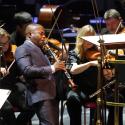
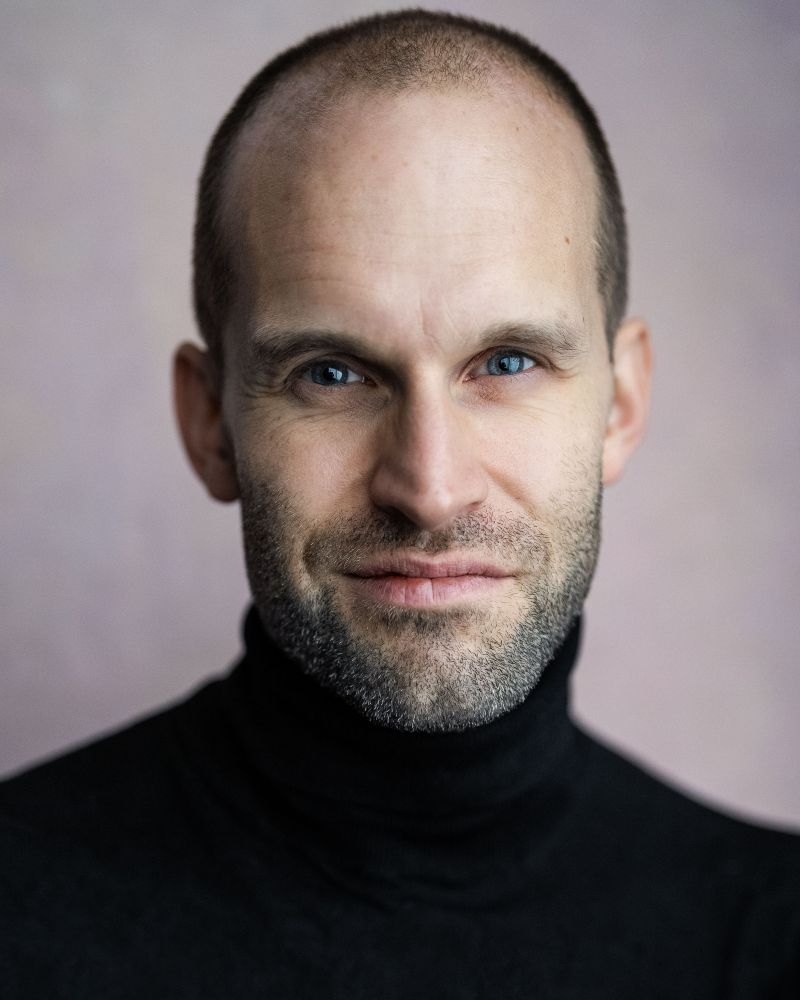 At the heart of the vocal performance was the fantastically commanding Christ of Ashley Riches (pictured right). He has an enormous voice, but he deploys it with remarkable sensitivity to the meaning of the words, and there was as much delicacy as richness to his performance, with some disarming vulnerability in the Gethsemane scene. Next to him, Hugo Hymas’ Evangelist was fluid and focused, as dramatically compelling in his Part One aria as in his narrative.
Every singer got at least one aria, and they were well contrasted as pairs. The pick of the rest was bass Frederick Long, who sang his arias with humane empathy, and injected strangely intense drama into the portrayal of the minor characters like Peter and Pilate. Matthew McKinney’s tenor was more vigorous and heroic than Hymas’, making his “Geduld” aria stand out as unique. First soprano Joanne Lunn had a beautiful, agile voice that was a little too big for the small space of the Queen’s Hall, so that her arias had a quality that was piercing as well as rich; second soprano Alys Mererid Roberts sang “Blute nur” with more statuesque focus. James Hall’s alto voice was bewitching in tone, but slightly lacking in control, “Erbarme dich” swinging in an unbalanced manner between dynamic extremes. Sarah Anne Champion, on the other hand, sang “Können Tränen” with heartfelt sweetness by comparison.
Butt built the whole thing upon the rock of the Dunedin Consort’s orchestra – or, more accurately in this case, orchestras – and their playing was of typically virtuoso quality. The pale edge of the vibratoless period strings added ab extra touch of sorrow to the betrayal scene, with its keening winds, and each of the obligati was expertly taken, particularly Jonathan Manson’s viola da gamba, which was effectively an extra singer. Its sound in “Komm süsses Kreuz” came the closest thing all evening to upstaging Riches’ singing.