When your special guest is a young soprano with all the world before her, the total artist already, your programme might seem to run itself. Yet the Dunedin Consort’s sequence seen and heard in Glasgow, Edinburgh and (last night) London followed a proper musical logic, running together an overture, a ballet and a cantata in the first half, and pulling focus on Handel’s early years in Rome, all supremely inventive music – though the later G minor Concerto Grosso which launched the second half is in a class of its own.
The Dunedins are as classy as said guest, Nardus Williams: both are poised, focused and capable of an amazing range of nuance in works which might seem relatively straightforward. I can’t help thinking about Bjarte Eike’s declaration that Handel is “only old pop music” – compared to Bach, yes, but there were moments worthy of JSB here, above all in the chromatic fugal theme in the Concerto Grosso and some of the shades of suffering in Hero’s grief at the death of her beloved Leander.
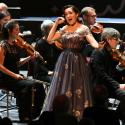
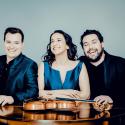
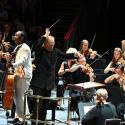
Ero e Leandro may be only one of the many cantatas Handel composed in the face of Pope Clement XI’s ban on opera, but it’s surely a little masterpiece, or felt so here, following on naturally from the minor-key sombreness in the Sinfonia and Ballo di larve from Admeto. It’s also a kind of triple concerto for voice, violin and cello. Brilliant, hyper-musical leader Matthew Truscott and cellist Alison McGillivray were Williams’ equals in lashing out at the “pitiless sea, cruel waves” which have claimed Leander’s life, while in turn many of the soprano’s sounds were pure instrumental heaven, using exquisite pianissimos to draw us in rather than force the drama outward. And her changes in the outer-section repeats were purely expressive, wondrously so in the one slow aria, “Si muora” ("Let me die"). 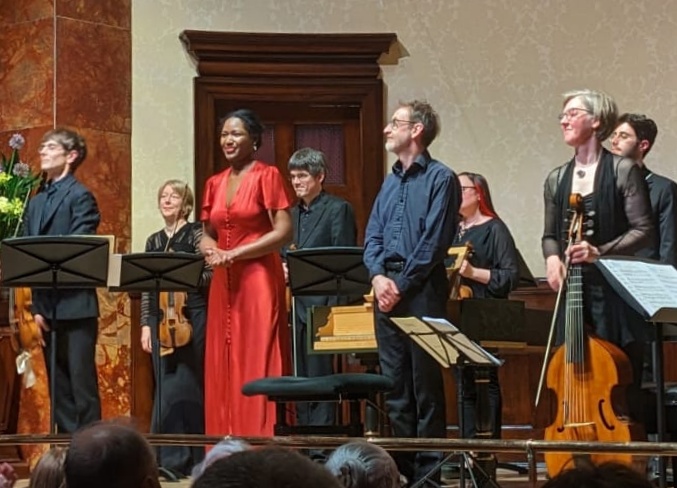 Tra le fiamme (Among the Flames) is a flashier piece of writing, to an extended flying-too-high conceit by Benedtto Pamphili (was it advising the composer not to get too big for his boots, as Truscott charmingly suggested?). Williams brought her full, vibrant voice to bear on the runs, which may not be to some authentic tastes, but again there’s always meaning, not show. McGillivray (pictured above on the right with Truscott, Williams, Stephen Farr and other members of the Dunedin Consort) took up the striking viola da gamba here, before the instrument’s even more remarkable role in “Per me già di morire” ("To die for me") from La Resurrezione, while as leader, Truscott not only made sure phrases in every work were shaped with singing artistry but also gave full value to the silences between the notes to heighten dramatic tension.
In this respect, the sublime glories came at the end of each half: “Tu del ciel ministro eletto” (“You, heaven’s chosen minister”) from Il trionfo del Tempo e del Disinganno took us to a brighter heart of the matter after Hero's suicidal grief, the Resurrezione aria went even deeper, and there was a perfect, flowing encore in the Siciliiano from another Roman cantata, Aminta e Fillide, re-engaged in Rinaldo. Lucky London to have two superb Handel evenings in succession, and two world-class British sopranos who live every moment of what they sing about, Williams very much following on the heels of Louise Alder's Theodora on Wednesday night (and not even using a score, standing proudly and unafraid before us ). I hope that this, too, like the Theodora, is being recorded.