

Their record label describes them rather laboriously as “a Baroque super-group of four superstar Baroque instrumentalists”, but the Retrospect Trio don’t need any fancy titles to prove their quality. Bringing together violinists Sophie Gent and Matthew Truscott (leader of the OAE) and Jonathan Manson on bass viol (principal cello of the Amsterdam Baroque Orchestra) under the direction of young harpsichordist Matthew Halls, this ensemble is all about unshowy musicianship. Joined last night by soprano Julia Doyle they offered up some of the best Purcell London is likely to see this year – with performances from Mark Padmore and the Britten Sinfonia, not to mention Scholl, Jaroussky and Ensemble Artaserse still fresh in the ears, that’s saying something.
There are those who might cite Dunstaple, Dowland or Byrd, but it was surely Henry Purcell who coined that bittersweetness that has proved so enduring a characteristic of English music. Nowhere is the composer more plangent in his suspensions, more daring with his dissonances than in his consort music. His fantasias, sonatas and suites represent a huge body of too rarely performed music. Although well represented on disk, with strong recordings from London Baroque and Musica Amphion as well as the Retrospect Trio themselves, the opportunity to hear these unsettling works live should be seized on by anyone for whom Baroque is the quick-fix, easy-listening strand of classical music.
Conflict, tension and gloriously deferred resolution is to be had here for the asking. Uniting fashionable French and Italian gestures within an unmistakably English palette, Purcell’s sonatas dare to show their working. Stripping back harmonic flesh to expose the grind and tumble of joints beneath, this is music that crunches in the ear and prickles on the tongue.
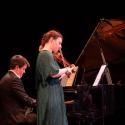
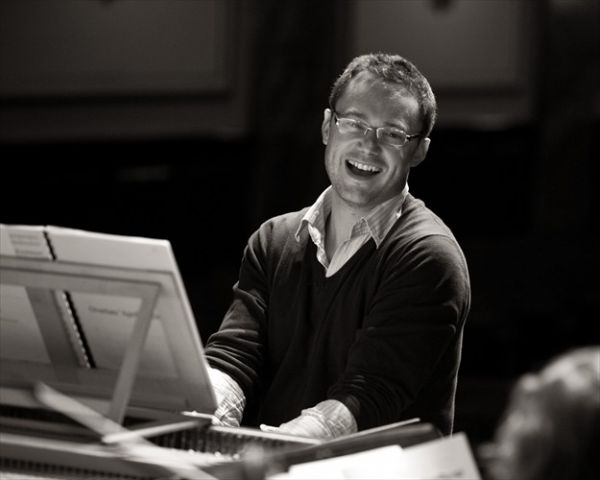 Delighting in the angsty encounters and push-pull shudders of tempo, the Retrospect Trio combine scholarship with an immediacy of delivery that is hard to look away from. It doesn't hurt that Gent and Truscott look like a pair of orphans from an Edgar Allan Poe story, come by way of Hoxton or Shoreditch: Gothic, hipster chic – all directional haircuts, cheekbones and big, dark eyes. The physical communication among the group is vivid, with both violinists favouring an explicit, generous approach to their period repertoire (though Gent’s wristy bowing technique sounds better than it looks). Halls (pictured right) was perhaps the greatest joy for me however, drawing some shockingly lyric flowerings as well as delicate wit from Purcell’s continuo writing.
Early-music regular Julia Doyle was the soloist for a selection of Purcell’s best-loved songs. Impossible to fault for taste or control, hers was a slightly matter-of-fact delivery that occasionally begged for a little whimsy or release from its authoritative musicality. Fairest Isle achieved a lovely (and unusual) intimacy – a real chamber performance – but lacked some of its space and stature in the process; both O Solitude and An Evening Hymn were coaxed with the softest vocal tone, but never quite felt cherished or enjoyed as their texts demand. Most successful were the more arioso-type numbers – the extraordinarily virtuosic The Blessed Virgin’s Expostulation and an unusual alternate version of "I attempt from love’s sickness to fly", all joyous vocal flourishes and mercurial shifts of mood.
The ashes of the old King’s Consort will glow with charged memory for a while yet I suspect, but the Retrospect Ensemble and its various offshoots make a compelling case for this new incarnation. Supreme in their interpretation of this repertoire, I for one will be keeping the Retrospect Trio's first Purcell disc on a loop, waiting and anticipating the sequel that promises to follow this autumn.
 Find the Retrospect Trio on Amazon





Add comment