

“Don Giovanni – Coming Soon” winked and nudged the publicity posters for English National Opera’s latest production. And just in case the entendre wasn’t clear they added a picture of a condom. Playful, provocative and just a little bit sordid, it captured the spirit of Mozart’s damaged seducer with singular accuracy. Too bad the revival of Rufus Norris’s 2012 production, though much changed since we last saw it, is still about as enticing as a second-hand sex toy.
Jeremy Sams has written a brilliant contemporary libretto – less a translation and more a free reworking of Da Ponte’s text. The bon mots gleam like the teeth-twinkle in a vintage advertisement, a shard of light in an otherwise grim and grubby production. Leporello’s 21st-century catalogue aria (complete with spreadsheets and graphs) gets a big laugh, as does the neat updating of Don Giovanni’s conquests – “Dark girls and fair girls, Swedish au-pair girls” – with extra points for later rhyming “Jacuzzi” and “floozy”. The libretto, which deserves so much better than Norris’s confused treatment, also gave us a new and rather striking moment of psychological realism in the Don’s serenade Deh vieni alla sua finestra. Rather than seduce yet another faceless woman he instead yearns for a “lost beloved” – a pure and uncorrupted love he can no longer regain. Coupled with Iain Paterson’s inward delivery and fragility, it was a rare moment of truth among chaos.
It doesn’t help that Paterson’s Don Giovanni is still a beautifully-sung cipher
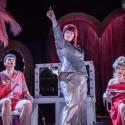
Things have improved in the two years since the premiere. Norris has stripped away a lot of heavy symbolism and crowd faff. Gone are the masked revellers who previously dashed and shrieked their way around in some nightmarish carnival, and also banished is the electric installation and its accompanying metaphor: that Don Giovanni, he’s so charged with sexual electricity it might just be the death of him. Unfortunately however nothing has really been put forward to fill the absence, so now where once things were baffling and cluttered, they are now vacant and dramatically flaccid.
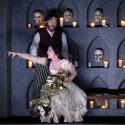
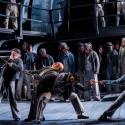
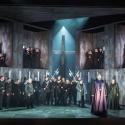
It doesn’t help that Paterson’s Don Giovanni (pictured below with Matthew Best as the Commendatore) is still a beautifully-sung cipher. Sporting a slightly better wardrobe this time around he at least stands a chance of playing a plausible seducer, but his casual naturalism just gets drowned out by Ian MacNeil’s riotously ugly sets and Norris’s background activity. Strong work comes from Darren Jeffery, who brings a comedic warmth to Leporello that predecessor Brindley Sherratt lacked. The interplay of the recitative between Jeffery and Paterson however lacks the pace it achieved last time round, although speeds generally are kept up by Edward Gardner in the pit.
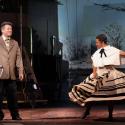
 Sarah Tynan and John Molloy reprise their roles as Zerlina and Masetto with as much charm and gusto as ever. Tynan in particular is pitch-perfect in her canny but delicately vulgar bride-to-be (who could resist her Batti, batti?), with Molloy gamely stepping up as her posturing fiancé. There’s strong work also from Sarah Redgwick as Donna Elvira, whose tightly-wound ardour plays out with technical efficiency.
Only Katherine Broderick’s Donna Anna disappoints, dramatically awkward and uncommitted, while her magnificent dramatic soprano (last time powerful but a little out of control) now feels a little too gripped and held-back. Her scenes with Ben Johnson’s Ottavio (elegantly sung, as ever) verge on the comic at times, with neither physically comfortable in their interactions.
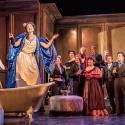
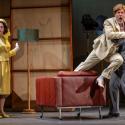
MacNeil’s sets are still cumbersome and bleak, framing the action in an indeterminate period of brutalist kitsch, somehow combining a back-alley rubbish dump for the Commedatore’s monument and a mint-green fantasy boudoir in the same production. At least the final descent to Hell has been improved (less electricity), though a few groans and a messed-up picnic could still do with a bit of help to bring things to the climax Mozart’s music intended.
You can make Don Giovanni a kitschy comedy or a gothic revenge tragedy and still have a great show, but there’s no excuse for it to be bafflingly, profoundly unsexy. Lose the sex and you lose the psychology along with it – that electric pulse of desire that Norris’s original production was surely striving to suggest. ENO has done right by their experiment and given it a second chance, but now it’s time to move on from this operatic coitus interruptus and find a new Don Giovanni with follow-through.
- Don Giovanni at the London Coliseum until 10 November

Add comment