The world premiere of Stephen Beresford’s new hourlong play, livestreamed to home audiences in four performances as part of the Old Vic’s In Camera series, was postponed a couple of times due to Andrew Scott undergoing minor surgery. Thankfully, the actor has fully recovered, and his performance of this affecting piece was certainly worth the wait.
Beresford’s play centres on the fraught relationship between Patrick and his absentee father. They first meet when the former is an awed, frightened eight-year-old, admiring this stranger’s flamboyant dress, stylish smoking and expansive tales involving foreign adventures, bar etiquette, and their grand Spanish ancestry. However, any hope that this is the start of an intimate relationship is swiftly dashed; with cavalier cruelty, his father says he’ll only come back to see him if young Patrick can solve a coin trick dubbed the Three Kings. It’s another eight years before they speak again.
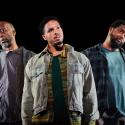
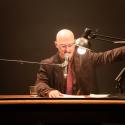
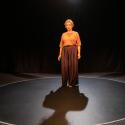
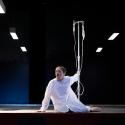
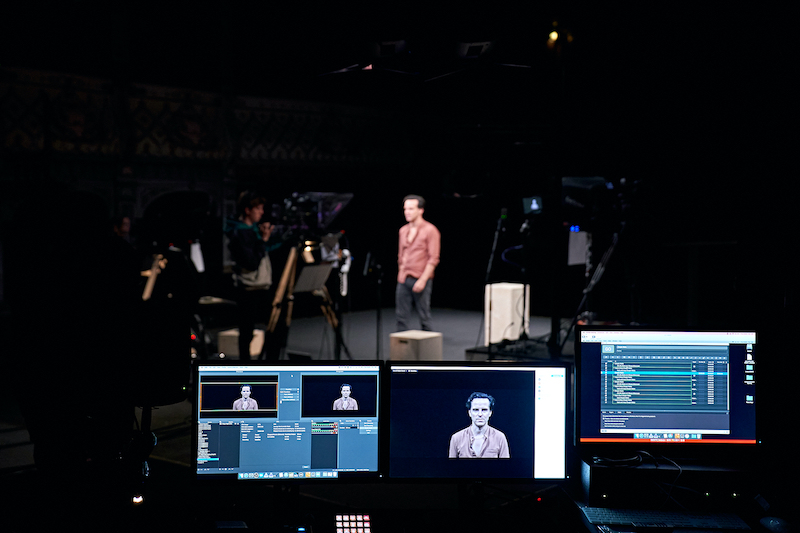
Scott (pictured below) evokes both characters with pin-sharp precision, as well as several others: Patrick’s vain, fragile, pill-popping mother, who disparages his father just as he does her; his older sister, who recalls them fleeing from debt collectors in Dublin; his father’s friend Dennis, awkward conveyer of yet more hurtful revelations; and his younger half-brother, also called Patrick, innocent and pathetically grateful for a shred of fraternal affection.
 Beresford’s incisive script constantly shows the agonising gulf between expectation and reality. “Men who love their families – I have an antenna for it,” says Patrick, and he knows that his father is not one of them. More heartbreaking: he admits that he isn’t such a man either; just like his father, he too is deceitful, a drinker, an irresponsible charmer, emotionally unavailable. That inheritance of sin is the devastating runner. The coin trick becomes a prophecy – “the force of one ricochets through the other two” – and as much as Patrick loathes his father, his self-loathing is almost more powerful.
We could certainly analyse the wider implications of that idea, while we, as a society, become increasingly aware of the importance of collective responsibility, and how the actions of one generation shape the next. But this is primarily an intimate character study, teeming with vivid descriptions. Patrick’s father comes more into focus with each detail: his daughter wryly recalls “he could only flourish in Georgian architecture”; we hear his distinct, sometimes amusing turn of phrase, as when he describes French as “a series of vocalised evasions”; there’s his troubles with the law, the compulsive womanising, the dodgy business ventures of the unrepentant chancer. Later, suffering from cancer, he’s also a conspiracy theorist railing against Big Pharma – but, at night, gripped by terror.
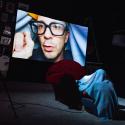
Partly by necessity for this scratch performance, Matthew Warchus’s direction is unfussy, but that suits the piece well. One major creative choice is very effective: a split screen, showing us Scott’s performance from different angles. That helps us imagine the dialogues between several people, as well as giving us both his body language and an immersive close-up. It’s riveting during key moments, like when Patrick’s drunken father reveals he’s remarried and had another boy, “the longed-for son and heir”. Scott somehow divides in two: the nasty drunk spitting this information down the phone, and the son absorbing it like a body blow. We also see a division, as when Patrick recalls vile email exchanges between them while, in the present, caring for his sick father – one hand reaching out to comfort him. Yet the monologue form means he is, ultimately, alone.
The use of sound effects helps summon different locations, including salsa music and chirruping cicadas. But the main focus is on this gifted storyteller, and Beresford’s piece is beautifully crafted for Scott’s range, giving him moments of fury, partly masked by biting humour and studied nonchalance, of raw pain (including a roar from the father like that of a dying animal), and of physical comedy – like an elaborate bow Patrick attempts while soused. There’s also an emerging examination of faith. Patrick uses the word “faithless” in multiple senses; this is a string of men who abandon their families, but who also feel untethered from a guiding power. A final plea for mercy is naked and humbling: that forgiveness which is not deserved, or earned, but can still be bestowed – perhaps to break a cycle and free the next generation.
- Three Kings was livestreamed by the Old Vic on 3-5 September
- Read more theatre reviews on theartsdesk