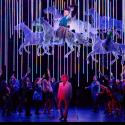
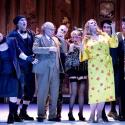
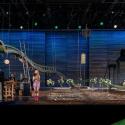
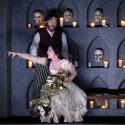
David McVicar's new Aida production had an opening mise en scène of such unashamed ugliness, a revolving main feature (a wall of scaffolding) of such audacious featurelessness, a wardrobe of such brazen tastelessness (think Dungeons and Dragons), that my critical faculties sort of went into a coma. I looked on, my mouth so wide open I was virtually dribbling, wondering what had happened to the great McVicar, praying for the return of a refreshed and fragrant reality, imagining that something - a fire, a flood - might intervene on my behalf between now and the end of the opera to restore the stage to sanity. And you know what happened? A miracle. By the start of Act II, the aesthetic cretinism had gone and many things of beauty and thought began to creep out onto stage.
Aida may be an opera-by-numbers, lurching between sclerotic clunk and clunking sclerosis, but it does contain some scene-stealing moments
Coursing through this new-found aesthetic coherence were nudity and ideas - fresh ones. The work, not famous for a dramatic litheness, seemed from here on in to acquire an ever-increasing speed. It had grown a combustion engine. We left the end of Act I in a burst of Bacchanalian blood-thirstiness - in which a topless, frieze-like movement among a group of murderous slave girls is unleashed on a human prey - and we sped into a highly pornographic, highly good value, orgiastic dance in Act II. McVicar imagines the barbaric, processional world of Aida as a repository for all our best-loved dystopias. One such dystopia is the dissolute court, as represented by that surrounding Amneris, the jealous suitor to war hero Radames, all of which nicely leads the mind to world of Salome.
Beyond this courtly formality and sexual violence are characters and costumes, processions and events that allude to a syncretic amalgam of every primitively vegetative and anomically advanced society we have ever attempted to conjure up. Hence, an indigenous barbarism dances around a post-industrial apocalypse. And a real show emerges, one full of leering voodoo, nubile ladies, bloodied gladiators engaging in martial art aggro and a cloud of human carcasses swinging from the rafters. So a bumpy start, but McVicar ultimately does come up with the goods. As does Verdi. Aida may be an opera-by-numbers, lurching between sclerotic clunk and clunking sclerosis, but it does contain some scene-stealing moments. The clarinet in act four, the flute at the beginning of act three that is the perfect misty accompaniment to Aida and Radames' water-borne elopement.
Voices rang out simply and often crudely. Robert Lloyd (the King of Egypt) was the definition of stentorian. Marianne Cornetti's Amneris was vocally if not theatrically effortless. Marcelo Alvarez (Radames) was the consummate hothead. Micaela Carosi (Aida) delivered her lines with a particular full-bodiedness and amazing disregard for the well-tempered scale.
It wasn't a cast with much holding power. The final scene saw all the voices cracking, thinning and sagging like an old face. Luisotti kept the orchestra going at a decently pacey standard. And, by the third act, McVicar had yet again run out of ideas. And still that bizarre chunk of scaffold, like some forlorn memorial to the decline of the building trade, kept revolving. McVicar at his best and worst.
- Aida is at the Royal Opera House until 16 May
- Check out what's on at the Royal Opera this season and in 2010-11