There’s just something about an opera orchestra when it’s let out of the pit. The Royal Danish Orchestra is more than that, of course – it makes much of its six centuries of history, and since its past members included John Dowland, Heinrich Schütz and Carl Nielsen, why wouldn’t it? But the qualities that leapt out most energetically from this concert at Symphony Hall – the Orchestra’s sole UK date on a brief European tour – were those you’d expect from a band with theatre in its blood: a vivid sense of musical characterisation, and an instinct for pacing a musical argument over an evening, rather than a movement.
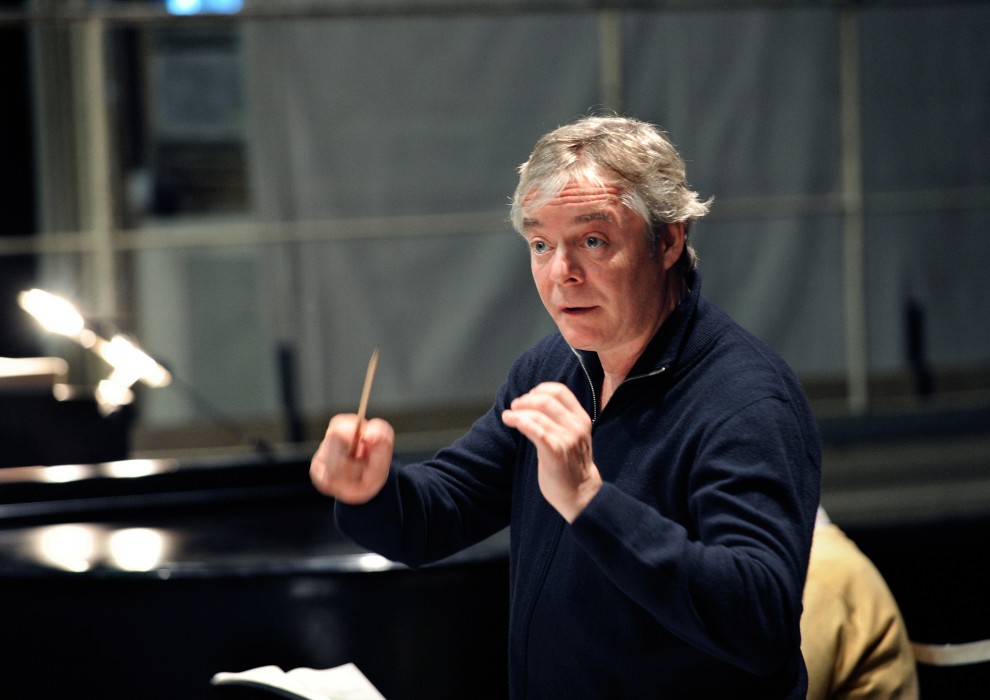
That instinct was all the more striking when you saw the way the orchestra’s principal conductor, Michael Boder (pictured below by Alexander Vasiljev), went about his business. A slight, elegant figure, he looked at times to be to be doing almost nothing beyond giving a tidy, unwavering beat. He simply stood there at the centre while around him his orchestra surged, danced and – over the 15-minute expanse of Per Nørgård’s Iris – shaped the musical line in one ravishing musical arc.
 Opening with Iris was a bold move, and proof of the orchestra’s stated determination not to turn this year’s Nielsen anniversary into an exercise in nostalgia. But from the whispered rustle of the violins’ opening paragraphs to the way the clarinet melody rose, late in the work, from within tissue-like orchestral textures, it could have been written for Symphony Hall, and the RDO players approached it like chamber music. Iris dates from 1968, and its place in this programme seemed like a deliberate attempt to assert classic status. On the strength of this performance, that seemed reasonable enough.
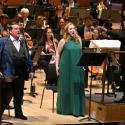
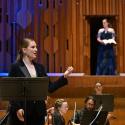
Still, even in 2015 nothing proclaims seriousness of intent quite like Schoenberg; it’s a depressing thought that Magdalena Anna Hofmann’s performance of Erwartung is almost certainly the reason why the house was less than half-full. The piece is a natural for an opera orchestra, of course, and Boder and the RDO darted, shimmered and swirled under and around Hofmann’s dark, lustrous voice without a false step. Hofmann herself told Schoenberg and Pappenheim’s horror story with cool control; as the implications of the words flashed across her face, she never forced her tone or descended into melodrama – making her short, sudden bursts of vocal characterisation all the more powerful. A ghoulishly rolled “r” here, a low hint of a snarl there: this performance was both intensely beautiful and unsparingly honest. On the opera stage, it would have been devastating.
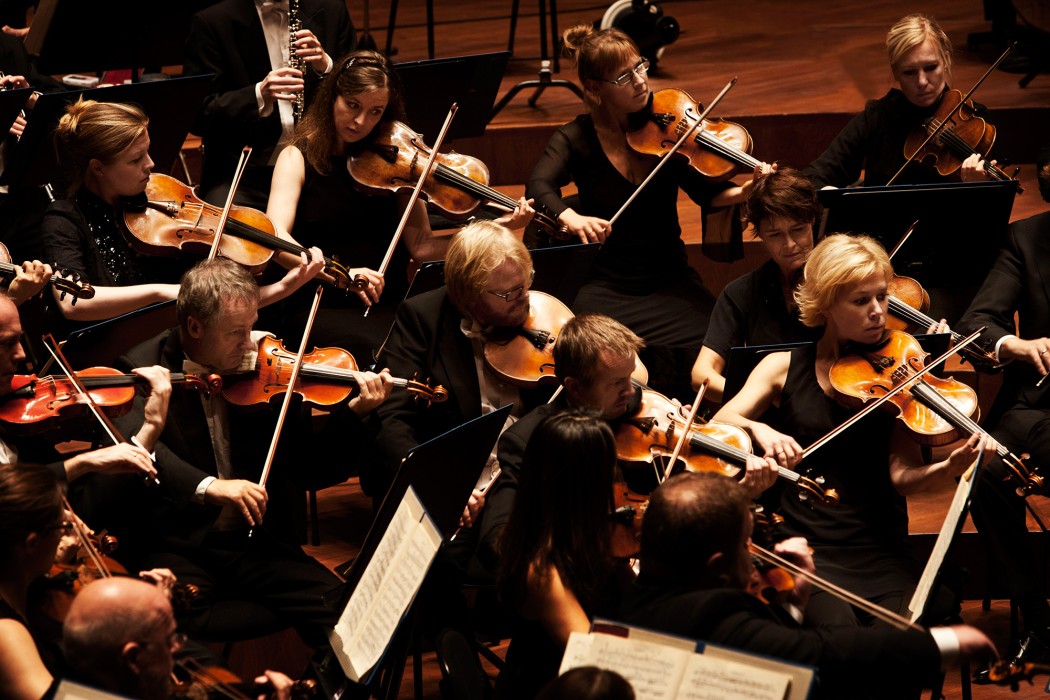 Unsparing honesty is very much Carl Nielsen’s line of business too; and with the Fifth Symphony we finally had a chance to hear Boder let his players off the leash. Woozy, overripe bassoons gasped out the opening theme; the percussion launched into their onslaught with raw malice, and the principal clarinettist peacocked shamelessly. No question, the RDO came across as an orchestra with character to spare. But the impression of a super-sized chamber group coalesced here into something more powerful.
No-one would say that the RDO strings (pictured above by Natascha Tara Rydvald) have a luxurious sound, but their transparency and sonorous power whipped up a genuinely menacing storm in the first of the second movement’s great fugal episodes. Put simply, they sounded like they meant it. All this, while Boder maintained his undemonstrative beat: letting his players play, and trusting them to understand where he was taking them – in this case, through a symphonic struggle which found resolution only at the last possible moment: almost at the very last note. The stakes can rarely have felt higher, and there was a slightly hysterical, off-the-hook edge to the encore (an uproariously OTT Nielsen Maskarade overture). In an uncompromising programme, perhaps Boder and the RDO’s greatest achievement was making the 150-year old Carl Nielsen seem the most dangerous man in the room.