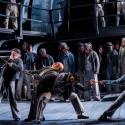
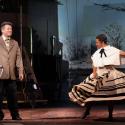
Backed up by reasonably adventurous orchestral programming, lucky conductors can forge a strong Stravinsky evening by picking and mixing from his five ancient Greek rituals. Sir John Eliot Gardiner, unintentionally homaging the late Sir Colin Davis who at least in earlier days would have jumped to such a pairing, chose to celebrate his 70th birthday with the extremes of white balletic lyric poem Apollon musagète and hard-hitting blackest tragedy Oedipus Rex.
Apollo’s celestial strings and the acerbic mix of brass with woodwind in Oedipus, all superbly aligned, guaranteed further contrasts. But with the ballet too rooted in the opera-oratorio’s sometimes muddy earth to soar heavenwards, the poles were not as far apart as they might have been.
Gardiner certainly dotted every "i" and crossed every "t" in Stravinsky’s immaculately shaded serenade for strings. The composer's musical realization of French verse rhythms projected perfectly; no entry faltered, no inner line went unclarified. There were chordal mysteries about the sun god’s birth, LSO leader Tomo Keller’s arrival as Apollo on the scene coolly charmed and the expected metaphysics arrived in the great Pas de deux, with Stravinsky’s gift for being simple when it matters underlined by the three throwaway refrains.
 Yet the violins, standing around the semicircle of cellos and violas, did not quite create the expected halo. And Gardiner’s usual rejection of romantic rubato – whether he can do it or not I’ve yet to hear – meant that the choreographic vision this conjured was that of Nijinsky’s deliberately mannerist, earthbound Rite of Spring poses rather than the soaring poetry of Balanchine, who properly arrived on the scene with Apollo. This sphinx-like score can taken many different interpretations; perhaps it's simply that I prefer one sort, and Gardiner another.
It might have been even more daring to put Apollo, as the totally unexpected 1928 sequel to Oedipus Rex, in the second half. That, as it happened, got off to an unexpectedly mirthful start. What on earth were the poor chaps of the Monteverdi Choir doing in zombie make-up above their black shirts and trousers? Did no one say at an early stage, "that’s naff, drop it"?
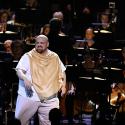
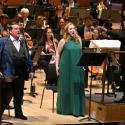
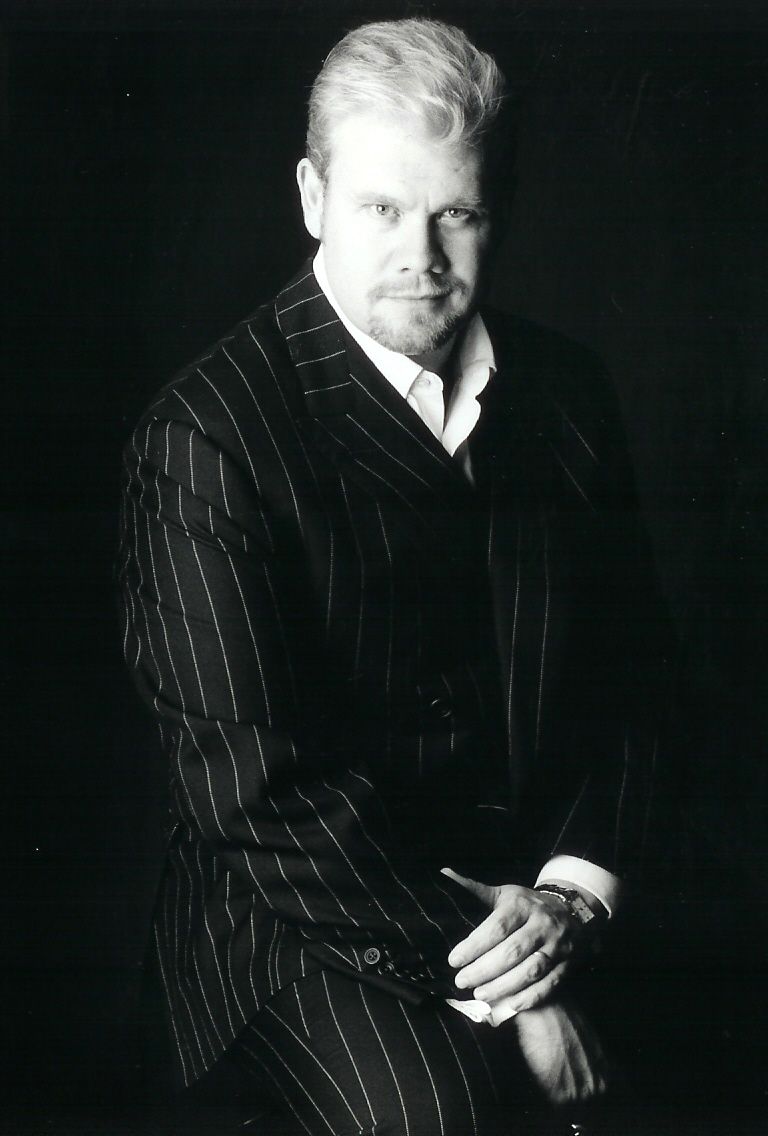
Anyway, they sang Stravinsky’s purposefully perverse accentuation of cast-iron Latin stunningly well, and yielded two true basses, Alexander Ashworth and David Shipley, as important soloists from the ensemble. As Oedipus, Stuart Skelton (pictured above by John Wright) was near-ideal: it’s difficult to get a singer who can cope both with the Monteverdian melismas and a stentorian leadership that quickly falters. Heldentenor Skelton smudged only a couple of runs, but an early payoff came in the clarion cry of "Ego clarissimus Oedipus" ("I, the most famous Oedipus"), the upper-register tone was golden throughout and he scaled down the voice to the blank realization of the truth in "lux facta est".
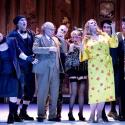
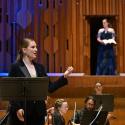
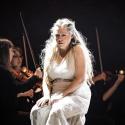
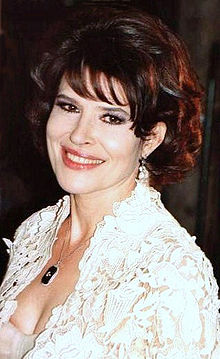 Stravinsky’s unity in diverse homages is difficult to find, and though similarly magnificent of timbre, Jennifer Johnston played Jocasta as Hammer Horror mamma rather than tragedy queen. That role went to the glorious Fanny Ardant (pictured left) – quite a replacement for the originally advertised Charlotte Rampling – in the spoiler-narrator role originally grabbed by librettist Cocteau; despite a frog in the throat, she could hardly have been more regal.
Hamming it up worse than Johnston was another, this time uncredited, tenor from the Monteverdis. The usually colossal voice of Gidon Saks as Creon, stage right, could hardly be heard from opposite-sided stalls, and this was a problem throughout: a too-loud orchestra never in sympathy with the soloists. Too much blaring in the first half of the drama robs the denouement, with what Bernstein described as a college football song gone crazy, of its sudden feral intensity. Plenty of interest, then, but not enough pity or terror about this Oedipus.