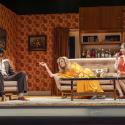
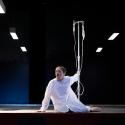
“My three men,” declares the deeply compromised heroine of this 1928 experimental drama by Eugene O’Neill. “I am whole.” Nina Leeds – hungry for love, ruthless with her own heart and those of others – burns like the sun at the play’s centre. She is given a portrayal by Anne-Marie Duff, in this fine production by Simon Godwin, so scorching that she all but self-immolates, while her men circle her like planets, helpless to alter their course. It is an impressive achievement – even if the work itself remains unwieldy and unsatisfying.
Designs by Soutra Gilmour, intricate yet breathtaking in their scale and spectacle, guide us through action that is at once intimate and epic. We begin in the book-lined study of Professor Henry Leeds, Nina’s Ivy League academic father (Patrick Drury), in the aftermath of the death of Nina’s fiance, Gordon, in the First World War. Tormented by a clawing regret that she never consummated her relationship with her beloved husband-to-be – for which she partly blames Leeds and his notions of propriety – Nina intends to dedicate herself to nursing, like a “peacetime Florence Nightingale” – and, what’s more, to give her body to any man who she believes might be made happier by its enjoyment.
The savageness, selfishness or discomfiture of the speaker are in revealing contrast to what social convention permits
Charles Marsden (Charles Edwards), a writer, worships her, but she has no more passion for him than for a comfortable old pair of slippers. Charles, meanwhile, is jealous of her friendship with Edmund Darrell (Darren Pettie), a doctor – though Edmund insists his concern is for her psychological well-being, and encourages her to find what he imagines will be peace in marriage to dopily besotted adman Sam Evans (Jason Watkins).
Nina submits to the arrangement, consoling herself with the prospect of a child into whom she can pour all her stymied love; she quickly becomes pregnant, but when Sam’s mother reveals a tendency to mental illness in the Evans family, likely to be inherited by the baby Nina is carrying, she is agonisingly thwarted once again. With implacable deliberation, she hits on a “scientific” solution – she will abort her baby, have an affair with Edmund, bear his child and raise it as her's and Sam’s. Thus, she reasons, she will bring happiness to both her husband and herself. As the decades pass and the Evans’ fortunes improve materially, Gilmour’s revolving sets propel us from a shabby sitting room to a glossy lounge with spiralling staircase encased in ornate wrought iron – an elegant art deco prison – to the deck of a boat. It’s a saga of an unconventional and decidedly dysfunctional family.
 In its original version, the play is challengingly lengthy, running at over four hours, and O’Neill’s main formal innovation is to include frequent asides in which the characters divulge their outspoken thoughts directly to the audience. Godwin’s production trims the text considerably, so that it comes in at closer to three and a half hours, and moves at quite a lick. As for the confessional asides, they have a curious flattening effect on the action. To the modern ear and eye they seem sometimes to be doing a slightly unnecessary job of explication, filling in subtextual gaps that as an audience we can plug for ourselves.
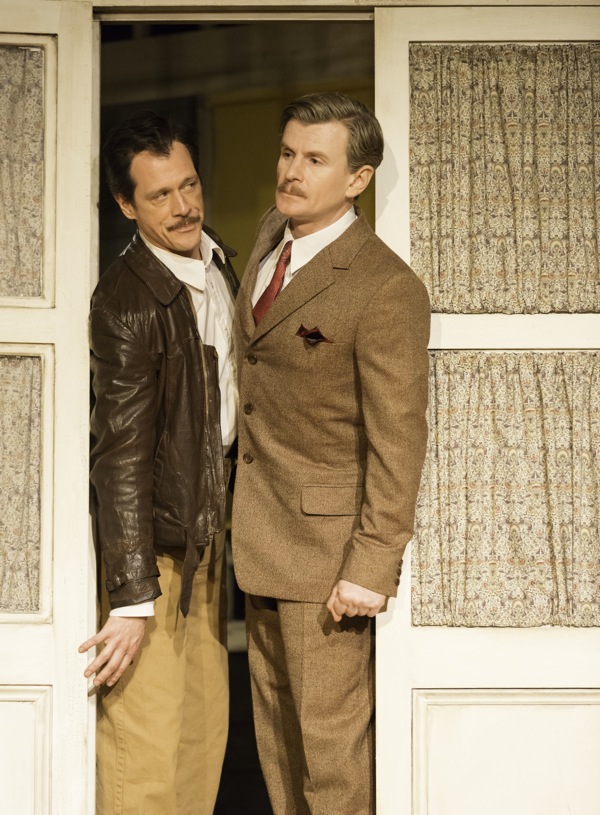
Elsewhere their effect can be melodramatic; more often it's comic, the savagery, selfishness or discomfiture of the speaker in revealing contrast to what social convention permits. This is frequently very entertaining – particularly in the case of Edwards’ long-suffering Charles (pictured above with Pettie), repeatedly exasperated at being eternally termed “dear old Charlie” and eventually spluttering in hopeless self-reproach as he lingers once again at the edges of Duff’s powerful erotic forcefield, “What am I doing here?” But sometimes the laughter obstructs emotional engagement, stifling moments of darker feeling.
The performances, though, are staggeringly good. Duff has a potency that is almost frightening. Crawling on to Charles’s lap for comfort, she’s a worn-out, tear-stained little girl. But there’s serious menace in her glittering eyes when she sets her sights on Edmund to father her baby, a touch of the maniacal to her laugh, and she is a remorseless seductress who will brook no refusal. Watkins is wonderfully touching as the simple, callow Sam, his trousers hoisted up beneath his armpits, his legs dissolving beneath him as he greets the news of his imminent “fatherhood” with rapture. Pettie’s Edmund is a mixture of urbanity and rueful weakness, and Edwards, all too aware of how clownish his love for Nina makes him appear, irresistibly mixes irritation and despair with doglike devotion. It’s an oddly frustrating play; but Godwin and his cast carry it off beautifully.