Wigmore Hall does not dish up a great deal of contemporary music, preferring a menu of mainstream chamber music. But this programme by the Nash Ensemble offered a different kind of mainstream: within the world of contemporary music this was a middle-of-the-road offering. A roster of composers including Harrison Birtwistle, Simon Holt and Mark-Antony Turnage, all at one time enfants terribles, now more les vieux terribles, made for a somewhat monochrome concert that was a bit indigestible, even for a modern music fan like me.
And is it ok, in 2021, to have a programme like this, comprising entirely white middle-aged/older men? (And, full disclosure, I write as a middle-aged white man.) I wanted to hear a youthful voice, a female voice, a voice from a different musical tradition than the modernist, post-tonal space all these composers inhabit. And not from a sense of worthiness or wokeness, but because it would have made a better, more varied programme.
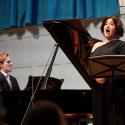
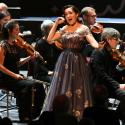
Boyd Tonkin, in reviewing Sarah Connolly on Tuesday, praised her for a well-filled recital, where other online offerings have tended towards the short. I would respectfully disagree with my colleague and cite this concert as evidence: it was long – coming in at about 100 minutes – with several pieces outstaying their welcome and leaving me wanting a bit less. I find it harder to concentrate on an online concert than when listening “in the room” and I think this needs to be reflected in the programming, particularly when the music is complex and new.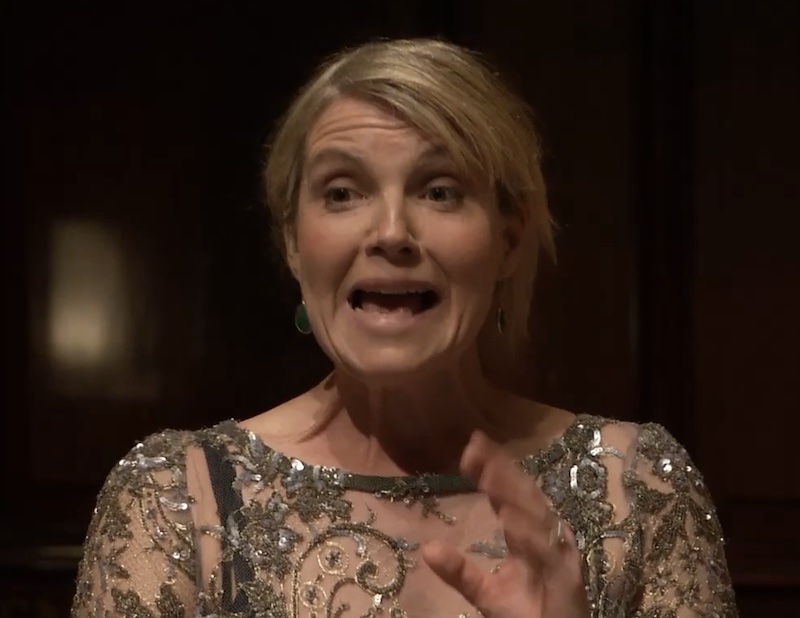 This may all sound a bit complainy and I should be clear that the Nash Ensemble’s playing was vivid and energised throughout, Claire Booth (pictured above) sang with character, passion and commitment in all her items, the stream was well filmed and presenter Andrew McGregor as personable and informative as always.
Each of the three world premieres emerged as successful in different ways. Simon Holt’s Cloud Shadow, depicting his Spanish home was a typically intuitive exploration of extremes of register, dynamic and tempo as the piece went from a skittering opening duet to a sombre kind of song for cor anglais (Gareth Hulse), contrabassoon (Ursula Leveaux) and bass clarinet (Richard Hosford). Colin Matthews’s Seascapes introduced me to a poet I didn’t know – Sidney Keyes, killed in action in Tunisia in 1943 at just 20 – and set his words in a Bergian, expressionist mode, with a richly lyrical soprano line that Claire Booth clearly relished.
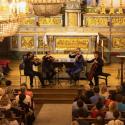
Mark-Antony Turnage’s Owl Songs are a tribute to his friend and mentor Oliver Knussen, who died in 2018, and who Turnage nicknamed “Big Owl”. The settings were by turns assertive, sparkling and – in the end – doleful, the cor anglais again underpinning Booth’s poised singing.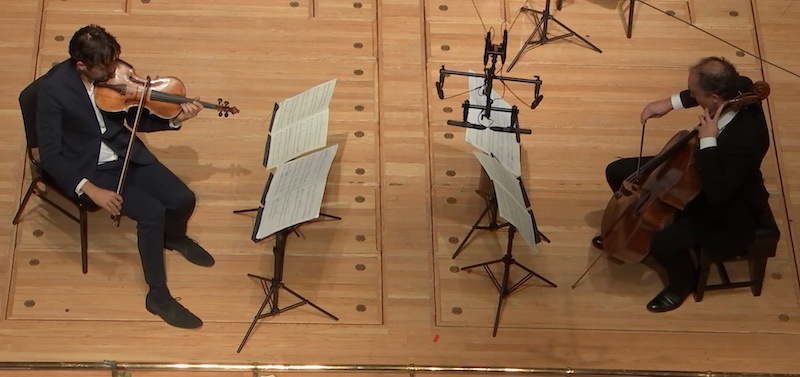 But Sir Harrison Birtwistle’s 20-minute Duet for 8 Strings, for all the tightness of the rhythmic connection between Lawrence Power’s viola and Adrian Brendel’s cello (pictured above), was a test of stamina for audience as much as players, and Julian Anderson’s solo string items Prayer and Another Prayer also felt overlong – not something I’ve ever felt about his music before.
It would have been so much better to have spiced this collection of illustrious establishment names with someone surprising, someone who doesn’t normally have a platform like this, someone who could tweak the tail of these older men who, once upon a time, were tail-tweakers themselves.