Successful performances, conductor Robin Ticciati once suggested to me, are when “the head has a conversation with the heart”. The same goes, surely, for great music, though from personal experience one has to reach a certain age to find that true of Brahms. Last night Igor Levit seemed to favour the head, occasionally missing, for me, that very elusive something at the heart of Brahms’s late piano pieces.
There can be no question of his magisterial oversight, though, or of how well 20 pieces in four consecutive opus numbers work in sequence. It was clear, for instance, how turbulence in one inspiration can meet with calm seeming simplicity in the next, and although constant audience coughing in the pauses as Levit was poised to move on shattered some of the magic, the intent was manifest (at least, after the interval, the move from the A minor Intermezzo to the A major in Op. 118 was allowed to proceed unbroken). The careful articulation of every chord, every note and the choice of when to lay on the sustaining pedal and when to cut off for pregnant pauses were irreproachable. And whenever Brahms dissolves the boundaries between outer and middle sections, Levit’s clarity helped us on the emotional journey – supremely so in the E flat minor Intermezzo of Op. 118, which felt like a Chopin Ballade (Brahms actually only gives that title once, in No. 3 of that sequence).
 Brahms described the Op. 117 trio as “the cradle song of my sufferings”, and it was here that the concentration of this listener lapsed, in the B flat minor Intermezzo; there’s a fine line between hypnosis and something frozen beneath the ice. Ultimately, it comes down to intuition – the hearer’s rather than the pianist’s – and there are introspections in these pieces which have more to do with personal feeling and less with the most refined dynamics (in which Levit was, again, irreproachable). Let’s just say that what I’ve glimpsed in the interpretations of Stephen Kovacevich and Nicholas Angelich (one of the underrated greats) didn’t happen here; Levit’s are valedictions forbidding mourning, or even tears.
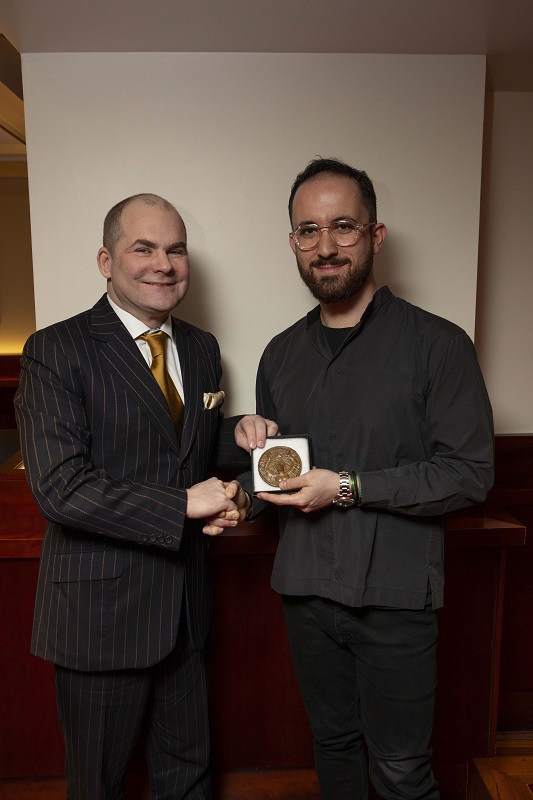
Even so, the more mixed bag of the final opus found him pitch perfect, from the frozen descents of the B minor Intermezzo through the eventual heartease of its successor and the light-hearted wit of No. 3 – such a key element in Brahms’s personality, suppressed in this sequence until that point – to what looks like a return to leonine youth, noble in E flat major, until a final tragic twist. Magisterial, certainly, and bravo to Levit for receiving the Wigmore Medal from CEO John Gilhooly. (pictured above) This was Levit’s 42nd concert, Gilhooly told us, a number in excess of the pianist’s years (he’s a mere 38); we can only look forward to everything until the 100th, and beyond.