

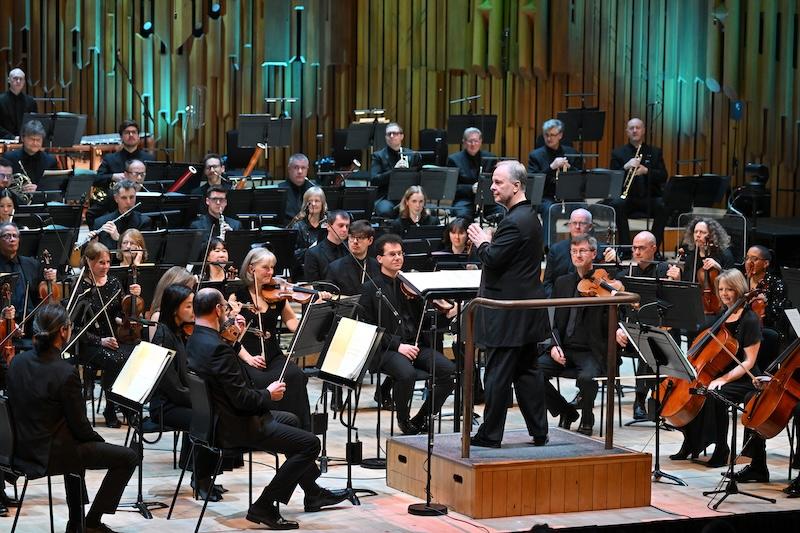
This programme – of Weir, Bartók, Finzi and Stravinsky – was right up my alley, and the BBC Symphony Orchestra and Sakari Oramo delivered on its promise, with performances that ranged from the grandly ceremonial in the Weir to touchingly intimate in the Finzi. In addition there was an enjoyable concerto for South Korean star Yeol Eum Son and, to finish, one of the great orchestral showpieces, The Firebird, or rather some of it.
I have known Judith Weir’s The Welcome Arrival of Rain forever, but performances in the concert hall are sadly few and far between. But it is great to hear it live, the BBCSO capturing its primary-colour orchestration and bold, sectional construction. The piece has a statuesque quality, with short-winded fanfares being decorated by string curlicues, but it builds gradually through its 16-minute span, the drums becoming more insistent, before the coup de théâtre at the end, the strings bouncing their bows and tapping their instruments to replicate the rainstorm of the title. The composer got a big reception at her curtain call, and rightly so.
Bartók’s Third Piano Concerto is the last piece he completed, and its sunny outer movement belie the fact the composer was dying, in desperate financial circumstances, far from his homeland. The wonderful opening melody was a bit undercooked by Yeol Eum Son, but from the second minute on any fears were dispelled. Son played with energy and lightness, although at times lifted from her seat to pound the lower register. Oramo, a wonderfully self-effacing conductor, always happy to keep a low profile, nonetheless uncovered some details in the orchestration I hadn’t heard before. The second movement, a haunting dialogue between a hymn on the piano and calm polyphony in the strings, was completely captivating.
Son returned after the interval for Gerald Finzi’s rarely heard Eclogue, for piano and strings. This starts with an almost Bachian counterpoint in the piano, a warm accompaniment gradually emerging – Oramo’s finding a wonderful sound from the strings. It was a refreshing palate-cleanser after the fireworks of the Bartók, Son showing herself adept in the deceptive simplicity of the piano part. The piece takes a bit too long to finish, for my taste, but I was glad to hear this piece of English pastoralism at its best.
The finale was Stravinsky’s Firebird in its 1945 suite version. There was lots to like here, from a ravishing pas de deux, an effervescent scherzo and properly violent “Infernal Dance”. The last two movements are the best bits, with lovely bassoon and horn solos and a big finish, Oramo revelling in the brilliant orchestration. Which just left time for a short Stravinsky encore, his riotous Galop, which Oramo clearly wanted to go faster than the orchestra did.


