

Old sins, the saying goes, cast long shadows. These are nothing, however, to the shadows cast by old productions. Jonathan Miller’s Mafia Rigoletto looms larger than most in this regard – a lowering giant of directorial inspiration, with 30 years in rep and as close to cult status as opera gets. As Christopher Alden’s new Rigoletto made his way through the darkened streets yesterday more than just assassins lurked in the shadows.
I say new, but of course this Rigoletto has almost as long and tortured a history as Verdi’s hero. It started life back in 2000 at Chicago’s Lyric Opera. Abandoned after a single run on the insistence of sponsors, it disappeared until 2011 when the Canadian Opera Company and English National Opera decided to resurrect it. Toronto saw the result first, and now – almost 15 years after its premiere – it’s ENO’s turn.
The production's many ideas keep battering you to think when Verdi’s music is pleading with you to feel
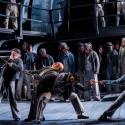
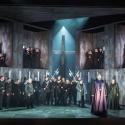
At first glance there’s really nothing here to merit the frenzied criticism and cries of betrayal that North American critics have hurled at Alden. The curtain rises on a Victorian gentleman’s club – all palms and oak-panelled walls, lovingly detailed. It’s Zeffirelli, Visconti, and calculated to put opera-goers at their ease. Which is when Alden pulls the Persian carpet out from under them.
Instead of a straight relocation to Verdi’s own 1850s we get a stylized (and, it must be said, stylish) social exegesis, with what might or might not be a memory play thrown in for good measure. There are so many ideas ricocheting around the production’s single room that the result keeps battering you to think when Verdi’s music is pleading with you to feel.
Foremost in Alden’s thoughts are social networks of power. His gentleman’s club (which could just as easily be an army barracks or a corporate board room) mirrors a score in which there’s no female chorus. Women enter the action of Rigoletto only as silent adjuncts – wives, daughters, servants – to be raped and discarded, we are reminded. But by picking this era Alden gets a rather intrusive set of ready-made illustrations.
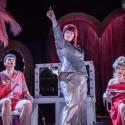
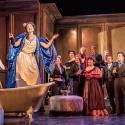
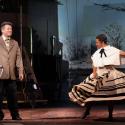
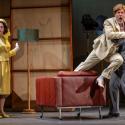
 A Mrs Rochester-esque woman (later revealed as Monterone’s daughter) darts wildly around the room in her petticoat – the mad woman in Victorian art’s attic let out to play. Sprawled across a sofa among all the suited male figures, she also bears more than a passing resemblance to André Brouillet’s notorious painting Une leçon clinique à la Salpêtrière, in which a young women slumps half-dressed, a human teaching aid in a room of medical students. It’s unfortunate that Stephen Langridge’s I Puritani at Grange Park has so recently mined this particular seam for effect, perhaps dulling me to Alden’s careful blurring of public and private, his claustrophic collapse of Rigoletto’s world and the Duke’s kingdom into a single room, always filled with observers.
Symbolically it works. Rigoletto’s self-deception is painted in every bar of Verdi’s music, in the stylistic lurches from his “Cortigiani” railings to his softness with Gilda. These are two worlds that cannot co-exist discretely and must eventually blur and bleed into one another, just as Alden demands in his direction of Hawaiian baritone Quinn Kelsey (pictured above).
Unfortunately technically the single set throws up problems. A veil-curtain often falls between Rigoletto and the action. Whether this is sleep or memory or yet another deferral is unclear, but it leads to long pauses in the action while shufflings and set-shiftings go on behind him. Between Act I Scenes I and II you just can’t afford this if the dramatic screw isn’t to lose all its tension. It also gives the opera little to play for. If we know we’re watching a memory, a story already played out, then there’s nothing at stake – none of that sense we get in the score of a drama inventing and reinventing itself structurally as we watch.
 The principal fascination for Verdi in tackling Victor Hugo’s Le roi s’amuse was the character of the jester. In Quinn Kelsey, Alden has a singing actor eminently capable of carrying the composer’s close psychological scrutiny. Singing with a looseness, almost a roughness, he makes Verdi’s ferociously high writing sound completely instinctive, conversational (if that conversation has been scripted by Shakespeare). It’s a performance worth going back a second time for.
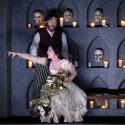
By contrast, Barry Banks’ Duke is polished and pretty. Like a too-skilled bassoonist tackling The Rite of Spring, he finds an ease to it that perfectly suits a character who doesn’t go in much for endeavour. He is matched for quality by Peter Rose’s Sparafucile. A world away from the spivvish take on him we’ve often seen from Brindley Sherratt, Rose is bluff and grandfatherly – an assassin with a code of honour and low notes as magnificent as his beard. Soprano Anna Christy (pictured above) was such a natural fit for the cold passion of Britten’s Tytania, but I struggle to find Gilda’s innocent warmth in her characterisation. Vocally she suits the role well, projecting nicely in the quartet and spinning an elegant if rather unmoving “Caro nome”.
None of the singers were greatly helped by Graeme Jenkins’ rather haphazard conducting. There’s pace and direction here, but last night too few speeds had settled and there was a lot of tugging between stage and pit.
There’s no denying the thought Alden has put into his Rigoletto. I haven’t even mentioned the onstage hanging of Monterone, the Giovanna who may or may not be Gilda’s mother, or the perplexing physical relationship between Gilda and her father. But I wonder if his vision of the opera really is shared with Verdi? This is a revolutionary work that casts aside the traditional structures of ottocento opera and discovers a new music-drama. It’s not a play about society, it’s about the psychology that society creates – the freewheeling, tragi-comic, rule-breaking humanity that can’t be contained in stand-alone arias and choral finales. And this is what Alden’s wide-shot Rigoletto lacks. We never get close enough to feel, and in so smart a show that’s the real tragedy.
- Rigoletto is at ENO until 14 March.


Add comment