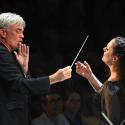
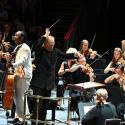
It’s a fair bet that more people now know Harmonielehre as the title of the 1985 orchestral blockbuster by John Adams than the composition manual written by Schoenberg in 1922. Even the title is “typically, ironically John”, as Sir Simon Rattle remarked in a pre-concert interview introducing the YouTube film of the concert. The piece has swallowed up its object of parody.
Yet the composer’s old programme note, reprinted for this LSO concert, disavows ironic intent. Adams hides his well-chosen found objects of late Romanticism in plain sight – Mahler’s Tenth, Sibelius’s Fourth, Schoenberg’s own Gurrelieder. Even in a performance as well-grooved as this one, what stirs the blood depends for its moments of overwhelming elation almost wholly on past masterpieces. There is something as unsettling as it is impressive about Adams’s skill as a symphonic seamstress, stitching together dead men’s clothes into a suit fit for mid-'80s America, the age of the space race, of Reagan’s star wars and of power shoulders coked up to ignore deep insecurities. “An amazing, detestable, fantastic work”: Claire Polin’s reaction to the Soviet premiere in 1990 stands the test of time much as the piece itself does.
Having played it several times under the composer’s functional baton, the orchestra knows Harmonielehre as well as anyone, and it showed in this sumptuously appointed account. Even Rattle’s tender care over the score’s more blatant appropriations, however, couldn’t disguise the becalmed progress of the middle movement, or prevent some passing vulnerability in the first violins from throwing the finale’s mesmerising accumulation of momentum into jeopardy.
Still more familiar to the LSO, coursing through its bloodstream after decades of performance under Sir Colin Davis, is the Symphonie fantastique of Berlioz. Yet it is Rattle’s special talent to have musicians play things his way. From the understated opening bars he established a sense of place and time, of Paris in 1830, without recourse to original instruments (though a proper cornet for Un bal and real bells in the finale made their presence felt). There was the drooping melancholy of Gluck about the first movement’s daydreams, and a breathtaking sudden access to the grand motets of Rameau in the glowing pure tone of its religiosamente final page. Here stood Wagner, or rather his lonely shepherd piping over the Cornish cliffs of Tristan’s third act, beside Christine Pendrill’s cor anglais in the Scène aux champs. As you might expect from Rattle, the ghost of Mahler joined the feast in the parodied waltz and march around it.
Too much like a history lesson? Don’t the best concerts have something to teach us? Don’t the great works hold past, present and future in balance? Rattle kept the 27-year-old firebrand composer in view and his model of Beethoven at bay – at least until the juiced-up finale, where bass recitatives set the scene as they do in the Ninth Symphony before throwing back the curtain not on an ode to joy but a witches’ rave, artificial stimulants courtesy of Berlioz.
- More classical reviews on theartsdesk
- The concert is available free to view on Youtube
- Follow Peter Quantrill on Twitter @peterquantrill