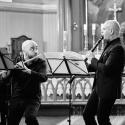
Isabelle Faust and Alexander Melnikov concluded their three-concert survey of Beethoven’s violin sonatas on the warmest day of the year. But the Wigmore Hall is always comfortable, and the temperature was well under control. The heat deterred the audience, but those who did attend made up with their impressive enthusiasm, unusual even for the ever-engaged Wigmore regulars.
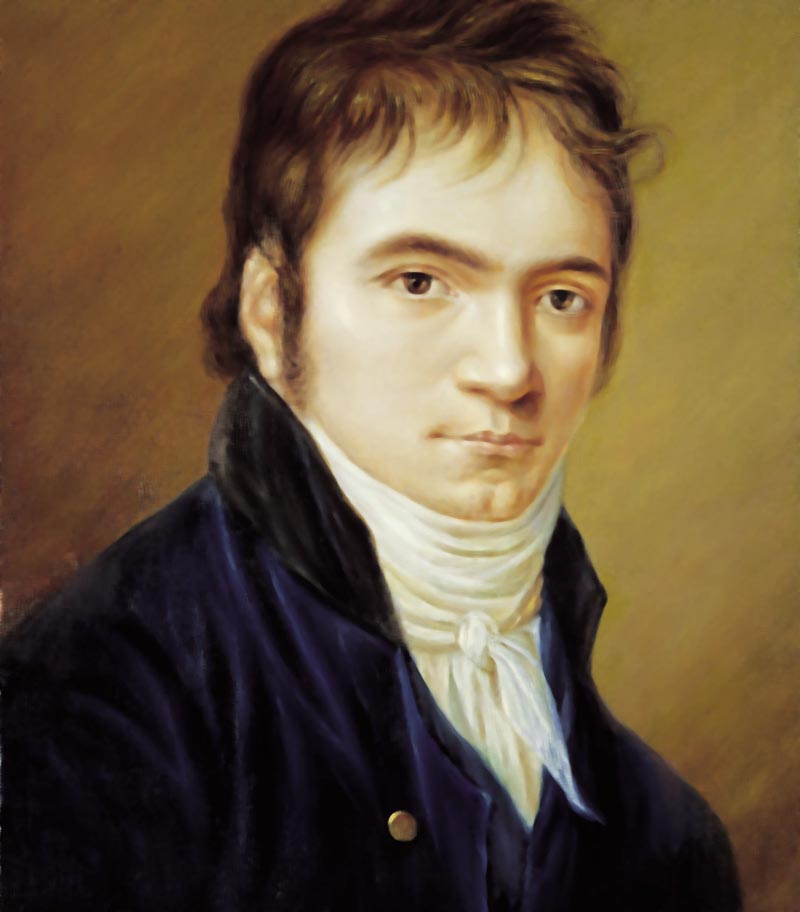
The performance was given on period instruments, still more the exception than the rule for Beethoven chamber music. For the first half, the Sonatas Nos. 4 and 5, Melnikov played a fortepiano appropriate to the era, 1800–01 a copy of an Anton Walter instrument by Paul McNulty (Beethoven pictured below in 1803, portrait by Christian Horneman). It has a small, angular case, in a spectacular blush rosewood. The tone is shallow and light. Faust performed on gut strings, which needed much tuning between movements, even with the Wigmore’s fine air conditioning. The Fourth and Fifth Sonatas are early-period Beethoven, with many nods back to Mozart, and with this instrumentarium, Faust and Melnikov were perfectly placed to highlight those 18th-century resonances.
This fortepiano sounds most “period” at the extremes, of dynamic and range. Beethoven generally avoids these, but when an outburst does come, the change in colour is striking, a percussive clarity wholly contrasting the instrument’s generally demure tone. Faust performed here with light, breezy bowing and minimal vibrato, employed to increase projection, but rarely for expressive effect. In the first movement of the Fourth Sonata,
 Faust cultivated an even, direct and slightly husky timbre. Beethoven’s melodies were allowed to play out with their own logic. Developments, though, were more adventurous. High, jerky interjections in the second movement Andante scherzoso were suitably acerbic, in short, emphatic bows. Acerbic, but not ugly. Every sound that Faust, and Melnikov, produced was elegant here, even at the drier end. The Fifth is the “Spring” Sonata and is filled with bucolic melodies that look forward to the “Pastoral” Symphony. Faust applied a little vibrato for these and seemed to find more variety of tone. The piano predominates, and often presents thematic ideas ahead of the violin. Faust matched Melnikov’s tone in each of these exchanges, and his variety of timbres and articulations gave her plenty of inspiration.
The concert concluded with Beethoven’s final violin sonata, the 10th. This still is not late Beethoven though, dating from 1812 (rev. 1814–15). Even so, Melnikov acknowledged the later provenance by switching to a more recent piano, another Paul McNulty, this modelled on Conrad Graf. The sonata is more lyrical, and Faust took every opportunity to bring out the music’s expressive potential. Her vibrato now was used for expressive effect, still moderate in scope, and still not ubiquitous, but more on than off. Melnikov’s instrument sounded more modern, but with a noticeably shallow tone in the mid-register. He also employed a fascinating effect in quieter passages, creating a wiry, hushed tone. This may have involved the una corda pedal, or perhaps even some other mechanical device, but the effect sounded like a completely different, and much older, instrument.
As with all these timbral devices, Melnikov used this effect sparingly, and Faust held centre stage. The Adagio espressivo was taken unusually fast – a period-performance affectation? – but succeeded thanks to Faust’s elegant delivery of the arching melody. In the finale, the mood and texture change often, as if Beethoven is continually shocking the audience back to attention. Faust and Melnikov were perfectly attuned to this game, giving the slow passages a sense of timeless free-flow, but then snapping back into the main tempo. As with everything on this programme, the result was a sense of surprise and spontaneity, valuable qualities indeed in such familiar music.
@saquabote