The word "after" can be elastic when a modern writer is inspired by a classic. Nima Taleghani here stretches it to breaking point, although, to be fair his piece is also described as a new play. It is not so much "after" Euripides as a celebration of theatre with frequent sideways reference - mostly knowing and comic - to The Bacchae.
 In many ways this is the perfect play for the beginning of a new era at the National. The origins of Western theatre are acknowledged in the choice of a Greek classic, played in the Olivier auditorium, itself inspired by Greek amphitheatres. And yet it throbs with the concerns and sounds of today, signalling director Indhu Rubasingham's intention for her time as Artistic Director to be forward-looking and to speak to a variety of potential audiences, including the young. She could hardly have been bolder: this is Taleghani's first play - he is an actor, best known as Mr Farouk in the Netflix series Heartstopper and as Lignière in Cyrano de Bergerac on NT Live - and it marks the first time a debut playwright's work has been presented on this stage, generally regarded as challenging even by experienced practitioners.
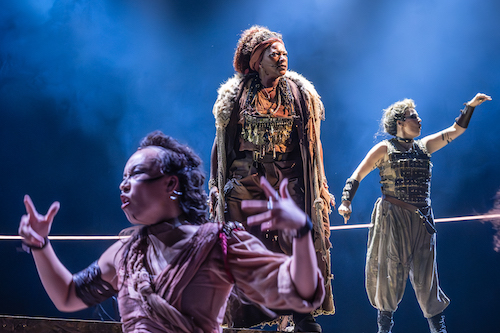
Experiment in this context is something of a tradition, however. Euripides was himself an innovator, introducing irony, mixing comedy into the tragedy. The Bacchae, the best-known of his 17 extant plays, was first presented posthumously at the Festival of Dionysos in 405 BCE. Subsequently, Dionysos (Ukweli Roach, above left) has sometimes been played by a woman or presented as of indeterminate gender. In the two earlier National Theatre productions of The Bacchae Wole Soyinka's 1973 version introduced a Yoruba deity and a second chorus to focus on colonialism and the slave trade. The actors in Peter Hall's 2002 production wore masks, according to classical tradition but unusual on a modern stage, and Harrison Birtwhistle's accompanying music was described by one critic as "the best most hypnotically complex rap music you have ever heard".
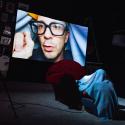
This time the play opens with a spectacular image: an enormous bloodied horse's head which is taken as evidence that Agave, the queen, is dead. Within minutes the stage is occupied by the Bacchae, wild, foul-mouthed, advocating liberation and - it soon becomes clear - kidnappers of Agave. This Chorus, all named individuals with modern preoccupations (one claims to be researching for her erotic novel) are led by tough Vida - played by Clare Perkins (below, centre) with loud-mouthed swagger, silencing ("Chill out, you little shit") and coralling the others. Perkins has no trouble in holding the Olivier stage.
So, we are already a long way from Euripides' opening with Dionysos explaining what is about to happen in a long monologue. The audience is often addressed informally and is gradually brought up to date with the background story, sometimes acted out by the Bacchae who seem to think of themselves as a theatre company. Dionysos is the son of Zeus and a mortal, Semele, whose sister Agave is the mother of Pentheus, king of Thebes. Whereas Euripides has Dionysos seeking revenge for the lack of respect for his dead mother and the refusal of the Thebans to worship him, here he is looking for a home. By the end, there is an explicit plea for the acceptance of migrants. There is nothing wrong, of course, with drawing modern parallels out of the classics, but this does put more emphasis on the human side of Dionysos's nature than fits with his immortality and ability to pull off magical tricks. Ukweli Roach makes him an engaging figure, more good friend than advocate of excess. The blind prophet Tireseus (Simon Startin, a sardonic presence) tells the truth unheard.
 Pentheus, King of Thebes and Dionysos's cousin, is strait-laced, petulant and narcissistic. James McArdle has a lot of fun with his self-aggrandisement and his simpering awkwardness when dressed as a woman to mingle with the Bacchae and meanwhile finding Dionysos attractive.
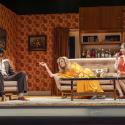
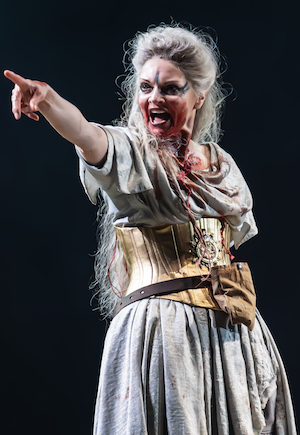
The problem is that we still need to get to the tragic ending. Despite being talented in both comedy and tragedy, Sharon Small (right) has an almost impossible task as Agave. She is required to kill in Bacchic frenzy, not just cattle (as in the original) but a messenger whom she gleefully eats, thankfully offstage. She re-enters, bloody and wielding a gory limb. The cartoonish overtones of this undermine the horror of her later killing of her son Pentheus imagining him to be a lion and - especially - her grief when, proudly bearing his head, she at last sees what she has done.
In the final scene Dionysos is delighted to be recognised as the God of Theatre. This is the real crux of the production. Exciting sound (DJ Walde, Ben and Max Ringham) and lighting (Oliver Fenwick), the playful meta-theatrical enjoyment of the ensemble, the sometimes rhyming script, the earthy choreography - plenty of clenched fists and kicks - by Kate Prince, designer Robert Jones' design - glittering, grungy or fiery as necessary - and Rubasingham's obvious confidence in directing on the Olivier stage add up to a celebration of theatre. Despite the drawbacks there is enough here that augurs well for the next few years.