Forget Anna Netrebko, if you ever gave the Russian Scarpia’s former cultural ambassador much thought (theartsdesk wouldn’t). It should be uphill from now on as Aleksandra Kurzak takes over the role of a diva out of her depth. Last night, though, she was unwell, and the role was taken by Ailyn Pérez, a lyric soprano who knows how to pull out all the right stops and whose dramatic truth complemented Oliver Mears’ production to perfection, presumably on little rehearsal time.
Mears plays mostly by the Puccini/Giacosa/Illica rulebook of love and terror in totalitarian Rome - foolish the director who would throw the musically and dramatically perfect guidelines aside – with an extra twist of contemporary violence in the second and third acts which is apt, if unsettling (when were torture and execution ever comfortable viewing?)
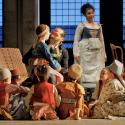
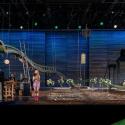
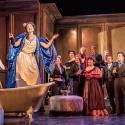
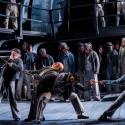
I didn’t quite see the results of set designer Simon Lima Holdsworth’s promise to go for the look of Rome’s wacky Sant’Ivo alla Sapienza in Act One rather than the original Roman setting, Sant’Andrea delle Valle, and the castle cannon transformed into bombing, complete with lighting flashes, as police chief Scarpia sets his plans in motion during the “Te Deum” at the end of the act didn’t really add anything. But the massive marble wall and gold door for his clinically clean office in Act Two and the queasy, striplit execution chamber of Act Three make this a Tosca with a difference. Clocks respectively big and small tell us that one murder, rather than the intended rape of the diva, will take place at midnight and the other, as originally planned, at 4am (we know how it’s going to happen from a third killing in the Act Three prelude). 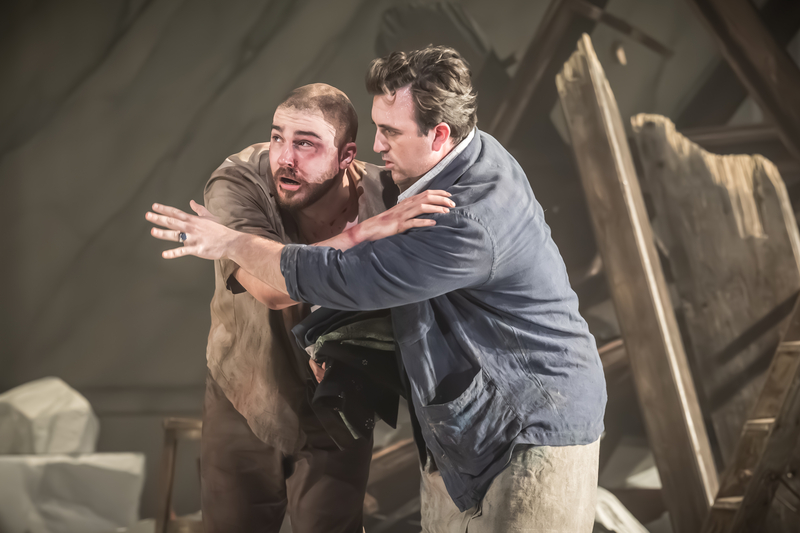 Hrůša, miraculously alert to every phrase and colour in a score as great in its way as that of any Wagner masterpiece, goes relatively easy on the first act. We need to love and laugh at the vibrant, easily sensual relationship between Tosca and her painter-come-freedom fighter Cavaradossi, even at her jealousy which Scarpia so skilfully manipulates to track his political prey. Though Freddie De Tommaso (pictured above by Marc Brenner on the right with Jette Parker Artis Ossian Huskinson as escapee Angelotti) tarted loud in his comparison of two beauties, you knew he’d be up to the big dramatic charges when they came – he even toned it down for a fine “E lucevan le stelle” - and he’s a plausible enough actor.
Pérez’s Floria Tosca is a hypersensitive but at first still likeable lover, credibly youthful as was Angela Gheorghiu when the previous production by Jonathan Kent first opened at the Royal Opera, but capable of going further than her in bite. Every top note hits the mark, subtle phrasing lines the characterisation, and all her reactions to the horrors that suddenly unfold in Act Two are credible, not histrionic. This was a “Vissi d’arte” which started with such refined, luminous emotion that it brought tears to the eyes. And in Act Three, we simply see the diva as a vulnerable girl who’s placed her trust in a lie – fake execution and safe conduct out of Italy – which Cavaradossi doesn’t believe for a moment. The touch of her theatrical bolt-upright when she tells him to act it nobly still brough a laugh from an audience hungry for humour throughout.
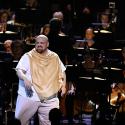
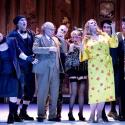
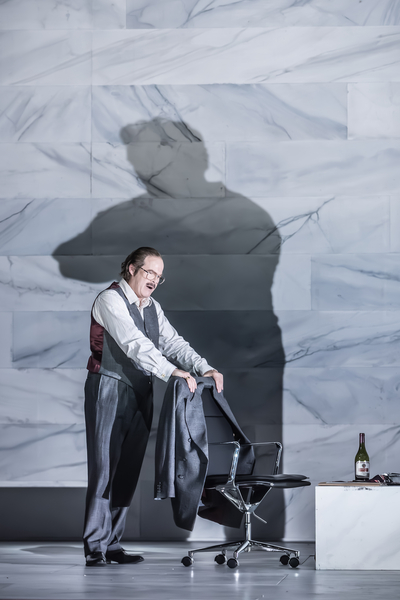 Having seen Gerald Finley not succeed many years ago as a treacherous seducer in Glyndebourne’s Don Giovanni, I was surprised at the all-round success of his Scarpia (pictured left by Marc Brenner). At first Hrůša matches his suavity and skill with an equally light touch, but the dark colourings which underpin the monster at the start of the next act fully complemented the murderous bureaucrat who wheels around on his office chair.
All the turns of the screw in the murderous thriller which unfolds are infallibly done, and it’s only at the curtain call that you properly register how this is an opera about a woman completely alone in a sea of officials and fugitives, with not even a female confidante to support her. In short, everything works. Curious to think that the Tosca the Royal Opera should have engaged for opening night, Welsh-Ukrainian soprano Natalya Romaniw, was singing the role in Wales - Stephen Walsh gave her the highest praise here - at exactly the same time.