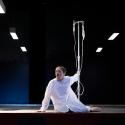
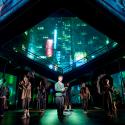
Kurt Vonnegut’s hallucinatory countercultural classic, Slaughterhouse Five, famously took his experience of being a prisoner of war in Dresden and turned it into a story about a man abducted by aliens whose life jolts backwards and forwards in time. It’s a testament to the So It Goes theatre company that this agile production – performed by four actors – simultaneously captures Vonnegut’s eye-spinningly deadpan humour and the horror that led to this becoming one of the Vietnam era’s great anti-war narratives.
Cream’s late Sixties song Sunshine of Your Life is playing as we wait for the action to begin on a compact stage where the front is divided from the back by a gauze screen. The opening of Eric Simonson’s adaptation – delivered by three members of the cast in military fatigues – is faithful to the initial paragraphs of Vonnegut’s quirkily unreliable account. “All this happened, more or less,” declaims one actor. “The war parts, anyway, are pretty much true.” "One guy I knew was shot in Dresden for taking a teapot that wasn’t his,” continues a second narrator. “Another guy I knew really did threaten to have his personal enemies killed by hired gunmen after the war.”
Director Douglas Baker explains in the programme that “At So It Goes Theatre, we like stories that feel impossible to tell onstage.” It’s a clever decision to make sure that Vonnegut’s voice remains a key character, since it enables the angry philosophy beneath the absurdity to resonate. Patrick McAndrew plays Billy Pilgrim, the man who becomes “unstuck in time”, shuttling between Germany in the 1940s and America in the 1960s. At first he is revealed looking dazed and confused behind the gauze screen, as the three narrators at the front of the stage turn to scrutinise him.
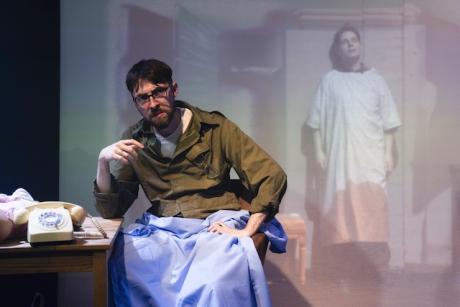
Baker has approached the conundrum of staging the roller coaster loop of Pilgrim’s story by creating a video design that’s projected onto the gauze screen. A calendar scrolls back and forth to tell us which year we’re in, while animations convey everything from the alien “Tralfamadorians” (shaped like plungers) to any characters that the multi role-playing cast can’t accommodate. We laugh when we register the absurdity of the Tralfamadorians’ anatomy, but the belief system that Vonnegut gives them, “When a person dies, he only appears to die… All moments, past, present, and future have always existed” clearly results from his trauma. He is still essentially in disbelief at the scale of death he has witnessed in the Dresden massacre, and as a consequence has lost his faith in humanity.
The gifted ensemble interacts with the video projections to whirl us through the disjointed episodes of Billy’s life. We see too how fractured time is integral to his disillusion – a chronological narrative would imply that things make sense, and for him they are never going to make sense again. One moment we see him almost drowning in a swimming pool as a child, the next he is explaining to his adult daughter why it’s all right for him to write a letter about aliens to the local newspaper. Throughout these random scenes, his time with his fellow American soldiers in Germany plays like a leitmotif; there’s no sense of heroism, just a sense of chaos till they reach the beautiful city of Dresden shortly before the Allies destroy it.
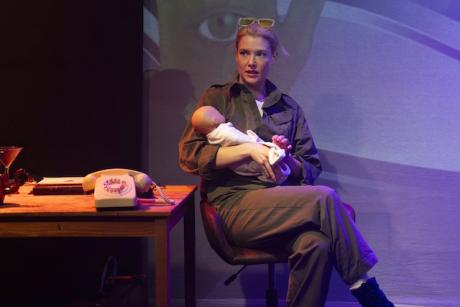
Sofia Engstrand (pictured right) demonstrates a cool versatility as she plays a range of characters including Pilgrim’s daughter and his wife. At one point she becomes a puppeteer as she manipulates toy soldiers in front of a camera so that they’re projected onto the screen as Pilgrim’s German captors. There’s a wonderful manic intensity to Alex Crook’s different guises (pictured top left), not least as Kilgore Trout, Vonnegut’s alter ego, while Ethan Reid puts in an enjoyably robust turn, including in his incarnation as the vengeful soldier Paul Lazzaro.
For me one of the key moments in the novel is the description of the bombing of Dresden backwards. Can anyone forget the impact of visualising the bombs being sucked up into the planes, the wounded soldiers becoming well again, and factories being used to dismantle the weapons so that any harmful substances they contain can be buried deep in the earth? I found it curious that Baker made the decision simply to show air raid footage backwards, rather than allowing us to feel the impact of Vonnegut’s words. But that’s a minor quibble about an admirably slick production that resonates particularly strongly as American military action takes nonsensical destruction to new levels, threatening the foundations of our increasingly fragile global order.