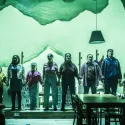
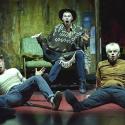
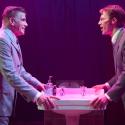
Gorky's satire is set in the summer of 1904, between the opening of The Cherry Orchard and Chekhov's death that year, and the first Russian Revolution early in 1905. Summerfolk has echoes of Chekhov, The Seagull as well as The Cherry Orchard, to which it could be a sequel. Gorky's folk, lazily holidaying in their summer dachas, might be inhabiting the new development which Lopakhin was to build in place of the cherry trees chopped down at the end of Chekhov's last play. The closeness of the relationship is explicit here: there is a reference to trees having been cut down to make space for the dachas and, in the final scene, the Raines add a line about Chekhov's recent death.
Throughout there are hints of impending political change, with a new kind of people set to lead society, about to overwhelm the lives of these middle class doctors and engineers as surely as it would Chekhov's ill-prepared gentry. Meanwhile, the summerfolk pass the time in jejune protestations of love, scribbling second-rate poetry, swimming, fishing, gossiping, arguing and putting on plays. The voices against this feckless life are those of women: Varvara who is dissatisfied with its wastefulness and Maria, a doctor, who reminds the others that they are the children of workers - cooks and washerwomen - and should be striving to improve society for everyone, not frittering away their opportunities. Unlike Chekhov, Gorky was a political activist, constantly under the watchful eye of the authorities. When first presented in St Petersburg (it was considered too incendiary for Moscow) Summerfolk caused a near-riot.
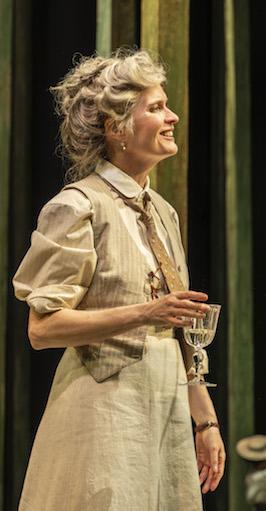
The playwright Raine siblings, Nina (Consent, Tribes) and Moses (Donkey Heart) might have been expected to update the piece, last seen at the National Theatre in 1999 in a version by Nick Dear. Thankfully, they have allowed contemporary resonances to speak for themselves, although they have trimmed the script (it ran to three-and-three-quarter hours in the earlier production) and added a directness to some of the language. References to sex are more explicit and, in the final act, there are a few "fucks" and a "cunt" as coarseness, fuelled by alcohol, and unbridled misogyny flavour the conversation. The overall effect of the Raine treatment is speedier, knocking off an hour's running time. The characters' languid lack of purpose coupled with a brittle anxiety about what the future holds (a state of mind that could scarcely be more up-to-date) remain undimmed, however.
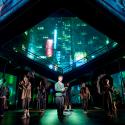
Speed serves the comedy well under Robert Hastie's beautifully modulated direction, with characters constantly on the move, forming and dissolving small conversational groups, rarely at rest on the Olivier stage. This is a sprawling ensemble piece, featuring 23 well-distinguished characters, all of them dissatisfied with life, either longing for love or desperate to escape unsatisfactory marriages.
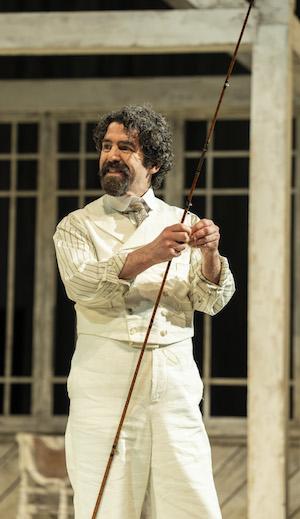
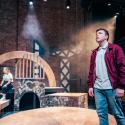
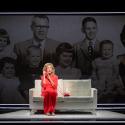
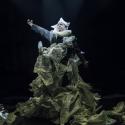
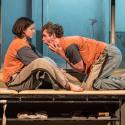
Paul Ready's crass Bassov (pictured right) is both obnoxious and very funny but there is something touching about his cloth-eared, incomprehension of his wife's unhappiness. Sophie Rundle's cool Varvara is detached without being priggish. She retains some idealism, but is disappointed that the writer she once admired, Shalimov (a posturing Daniel Lapaine) and hoped would bring about worthwhile change is, after all, as shallow as everyone else. Justine Mitchell (pictured above left) believably combines Maria's noble sentiments about doing good with an honest need for sex, even, if necessary, with Varvara's young brother Vlass (Alex Lawther) who has ostentatiously declared his love for her. Doon Mackichan as Kaleria the aspiring poet is comic in taking herself too seriously while Arthur Hughes as Suslov, the engineer, isn't much interested if his buildings fall down and mostly ignores his wife Yulia's (Adelle Leonce) ongoing affair. Overworked doctor, Dudakov (Sid Sagar) and his complaining wife, Olga (Gwyneth Keyworth), are unusual in having an on-off happy marriage. These people are almost all ridiculous and heading for a tragedy that they seem to intuit but not understand,which makes them at least recognisable, even forgivable.
Peter McKintosh's sets suggest simple interiors and a forest of tall plank-like trees. He has introduced very real water, however, for paddling and taking a dip, perhaps to emphasise the isolation of this group from what is happening in the world beyond their disappointing idyll.
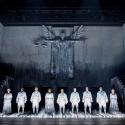
The watchmen in this version have more than a distant presence and complain about the mess always left for them to clear up. At the end, as the women take their future into their own hands, the Raines and Hastie bring the sights and sounds of the Revolution into sharp focus.
This is a welcome revival, a fascinating study of human frailty - funny and timely.