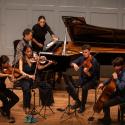
Conversation just before this concert started concerned Verdi’s Il trovatore and the truism that it needs “the four greatest voices in the world”. Whether or not the quartets we heard by Mozart, Prokofiev and Brahms demand the same in string terms, they all hit breathtaking levels of humanity, thanks to the singing interaction of the Jerusalems, the peerless chamber music equivalent of the Berlin Philharmonic.
Never has Mozart’s D major Quartet K575 sounded more like one of his great comic (or semicomic) operas, with only passing shadows like the sudden unison gruffness of the Menuetto. The genius who even in the simplest-seeming music lets each individual instrument shine came constantly to the fore, with Kyril Zlotnikov, who makes some of the most beautiful sounds to come from any cello, world-class-soloists included, on a par with the supreme stylishness of first violinist Alexander Pavlovsky.
Nor could Prokofiev’s Second Quartet have had more trenchant advocacy; audience members came out reeling at the originality of it. Which is perhaps surprising given that the composer, a wartime refugee sent 900 miles from Moscow to the “Kabarina-Balkarian Autonomous Region” (now Republic), was encouraged by the Arts Committee Chairman in the capital Nalchik – conductor Yuri Temirkanov’s father, no less – to incorporate local folk melodies in his work.
The ideal response to this complexity came in the serene detachment of the Adagio from Haydn’s Quartet in F minor, Op. 20 No, 5 They’re beautiful and vigorous in themselves, but quite apart from the acerbity Prokofiev could with licence incorporate in their initial treatment, they’re developed with a ferociousness that in this stunning performance brought them close to the pain and anguish of the so-called “War” piano sonatas, 6-8: another way of evading censorship, though Shostakovich – who quoted the Adagio’s lovesong in his Sixth Quartet of 1955 as a memorial to his colleague after Prokofiev’s untimely death two years earlier – didn’t try that evasion at the time.
In this perfectly contrasted programme, the most elusive and troubling quartet, Brahms’s C minor masterpiece spanning a decade of his creative life, came last. Even by the standards of what they’d unleashed in the Prokofiev, the Jerusalems’ febrile energy was on call in the restless, volatile outer movements, their movement mirroring the flexibility of their style. The Romanze, for all its lyric beauty, maintains the inward questing; only in the sort-of-scherzo’s trio does warm good humour surface, always a surprise in Brahms.
The ideal response to this complexity came in the encore, personably introduced by viola-player Ori Kam: the serene detachment of the Adagio from Haydn’s Quartet in F minor, Op. 20 No. 5, where Pavlovsky gave the impression of improvisation in his elaborations and descants: a paradigm of the whole concert, so seemingly free yet so disciplined.