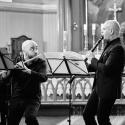
James Crabb is a musical magician, taking the ever-unfashionable accordion into new and unlikely places, through bespoke arrangements of a spectrum of pieces which brim with wit and inventiveness. This lunchtime concert with violinist Anthony Marwood was a sheer joy, as they together traversed a range of style and tone, richly entertaining a very decent Bank Holiday crowd in the Wigmore Hall.
The starting point was an obvious one: the tangos of Astor Piazzolla. This sequence of three run together had a reassuring familiarity, and a strong whiff of the Parisian café. The swooning violin melody intertwined with countermelody from the accordion, all suaveness and chic, as if for the delectation of a desultory crowd of coffee-drinking flâneurs.
Crabb arranged Thomas Adès’s Märchentänze from its violin and piano original (there is also an orchestral version). Based on English folk music sources which sit near the surface, it is good-humoured and genial music, Adès in relaxed mode. The first movement starts with skipping harmonics on the violin creating a music-box quality, leading into a main section with quirky wrong-note harmonies before a storming ending, both instruments plummeting to the depths of their ranges. The second is plaintive, yearning and so, so bleak, the third a collage of birdsong and the fourth a delightfully rowdy battle between the instruments, with spiky and unpredictable games of syncopation.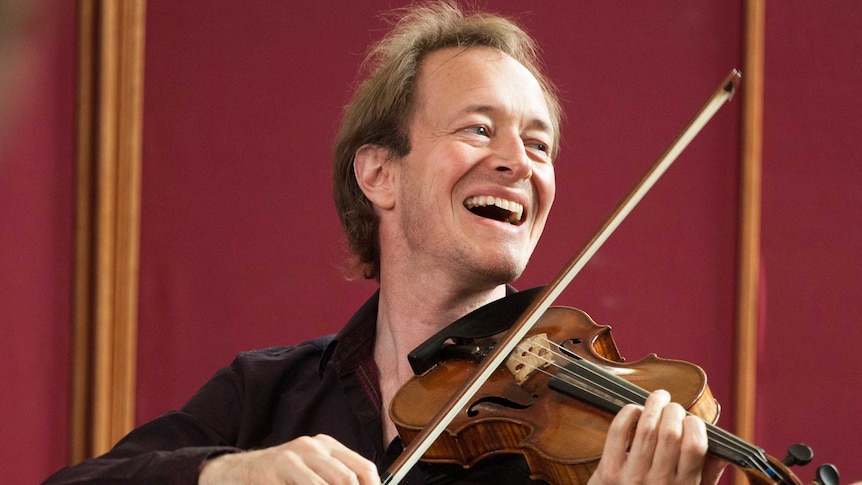 Crabb sat with his accordion on his lap, somewhere between a suitcase and a slinky spring, at times looking like it was trying to escape and set up on its own. But his command of the instrument and its resources is complete, and well displayed in his arrangement of The Lark Ascending. This is a reimagining more than just a tweak of the piano original: the accordion offers the sustain of the strings version but with a reedier, gutsier sound. It certainly threw a new light on a familiar piece, emphasising the vulnerability of the violin line, and the percussive and colouristic effects Crabb coaxed from his instrument gave a new perspective on the strangeness of the music. In the final bars, as the violin floats ever upwards, the accordion played just unpitched breathing sounds, a quite stunning effect.
Sally Beamish’s “Lament” from Seavaigers was desolate and icy, conjuring both Scottish folk music and the Scottish landscape over a drone accompaniment and offset by a glittering, dashing Northumbrian fiddle tune, both players vying to be the centre of attention. But even more impactful was the beautiful encore, Niel Gow’s Lament for the death of his second wife, with Crabb’s bag of tricks now replaced by a simple chordal accompaniment to Marwood’s heart-piercing melody.