

Concerts at the Wigmore Hall offer many types of pleasure, but not often an evening so straightforwardly fun as Monday night’s recital by baritone Benjamin Appl and Lithuanian accordion virtuoso Martynas Levickis. Appl is primarily a Lieder singer – but here dived into a stylistically diverse world of music ranging from Mahler to Copland, via Ravel and Kurt Weill.
There were passages of seriousness: Gustav Mahler’s dolorous opener, leavened by the sunny and saucy Alma Mahler that followed, and Reynaldo Hahn’s touchingly ingenuous take on Bach, “À Chloris”. Bernstein’s “Simple Song”, from his Mass, was sincere and eloquent, although perhaps the least successful item in its realisation for accordion. But for the most part we had levity of one sort or another: Hahn’s hilariously overwrought “C’est a Paris!”, Gershwin’s camp “By Strauss”, which Appl delivered in a heavy Viennese accent, and Copland’s nonsense song tongue-twister “I bought me a cat”, which was repeated as an encore.
Appl was dapper in a white jacket, with Levickis (pictured below) looking so much like a Reece Shearsmith character in Inside No. 9 that I expected him at any moment to leap up and commit foul murder with his instrument. But instead they made a marvellous team, with Levickis the most responsive of accompanists – and that word sells him short, this was a duo performance. There was no note in the programme – or in the spoken introductions – to indicate the source of the arrangements, with most of the pieces not originally scored for accordion. Perhaps they were by Levickis himself? Whatever, they were excellent: stylish and fully exploiting what Levickis calls his “magical box of tricks”.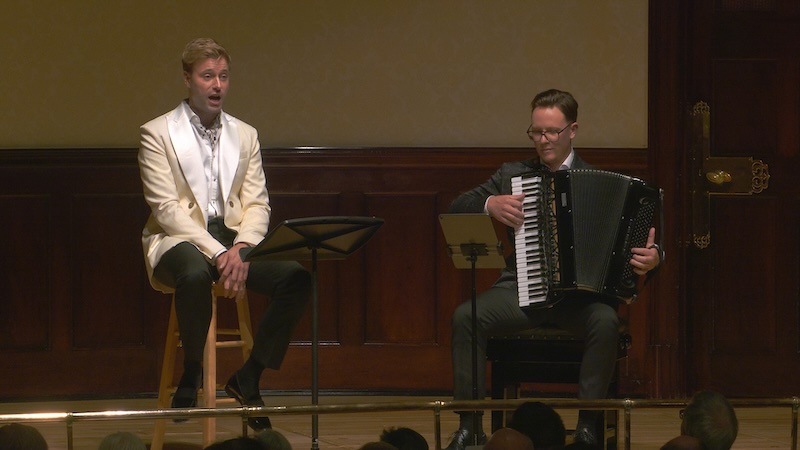 He had three solo items, of which two were revelatory. The famous Chopin Waltz in C-sharp minor could have been in its Platonic form here, even down to the coincidence of the top note of the instrument being the required high C-sharp. Levickis was equally winning in the swooning Parisian bar music section as he was in the fleet and flying fast section, and I’m not sure I can go back to hearing it on the piano. The Piazzolla with which he began the second half also gave me pause. Not one of his tangos – which can get a bit samey – Oblivion is a mysterious and moody milonga (a Uruguayan dance) and Levickis coloured it with a brilliant vibrato effect on the keys. Only Philip Glass’s Etude No. 6 was a dud – not in the performance, but in the meretricious vacuity of the music.
But I spent most of the evening with a smile on my face. Appl’s delivery was intimate and only occasionally opened the throttle, such as in the boisterous roister of Ravel’s “Chanson à boire”. Appl’s sinister mock-innocence in “Die Morität von Mackie Messer” was genuinely chilling (although perhaps we didn’t need the trigger warning on the front of the programme) and he did a fair Marlene Dietrich impression in “Ich bin von Kopf bis Fuss auf Liebe eingestellt”, better known in English as “Falling in Love Again”, slipping into half-speech and tapping into Dietrich’s Weltschmerz. The two hours flew by, and I’d happily have listened to it all again.


