This concert was advertised as the completion of an Elgar symphony cycle, though in the absence of the reconstructed Third, that meant the second of two. Both were planned with interesting concerto couplings. The First Symphony was presented with the Tippett Piano Concerto earlier in the week, and early publicity for this concert promised a new piano concerto from Mark Simpson, with Icelandic pianist Víkingur Ólafsson.
For reasons unspecified, that concerto failed to appear, so instead Ólafsson performed the more familiar Schumann. The result was an audience-pleasing combination, though the promise of that Simpson concerto remains tantalising. The concert opened with the Mendelssohn overture The Fair Melusina. Gardner’s tempos were gently but insistently propulsive. Throughout the concert, the LPO projected a warm, bottom-heavy string tone, aided by the double basses positioned high up on the left of the stage. That big, warm sound supported Mendelssohn’s always winning melodies, especially from the woodwinds. But for music so fleet, the big orchestral textures felt too tubby and round. Still, it is always easy to get drawn into that gorgeous string sound.
Ólafsson (pictured below) is a difficult musician to pin down. He is a household name, thanks to a high-profile recording contract with Deutsche Grammophon. But, as his plan to premiere the Simpson concerto demonstrates, he is also keen to explore new territory. His performance style is similarly diverse and contradictory. There is a lot of emotive gesturing – hair flicking, leaning into the keys, craning his neck to hear the violins behind – but the sounds are more controlled and refined. He makes a gorgeous tone on the piano, no doubt an important part of his commercial success, warm and with lots of pedal. His phrasing was sometimes erratic though, and he did not always connect fully with the orchestra.
In one passage of the first movement, the piano exchanges phrases with the solo oboe. Each oboe phrase was presented straight, but then followed by a highly emotive and flexible version from the piano. That said, Gardner again drew a wonderfully warm string sound to match Ólafson’s tone. The first movement cadenza was the only passage where Ólafson indulged in high-level dynamics, and it was all the more effective for his restraint elsewhere. And the second movement, Intermezzo: Andantino grazioso, proved an ideal vehicle for the celebrity recitalist, gently unfolding like a Chopin nocturne, discreetly supported by wispy woodwind obbligatos. After the performance, a short presentation by the Ambassador for Iceland named Ólafsson as CoScan’s "Nordic Person of the Year", in response to which Ólafson gave an encore, an arrangement of an Icelandic folksong. 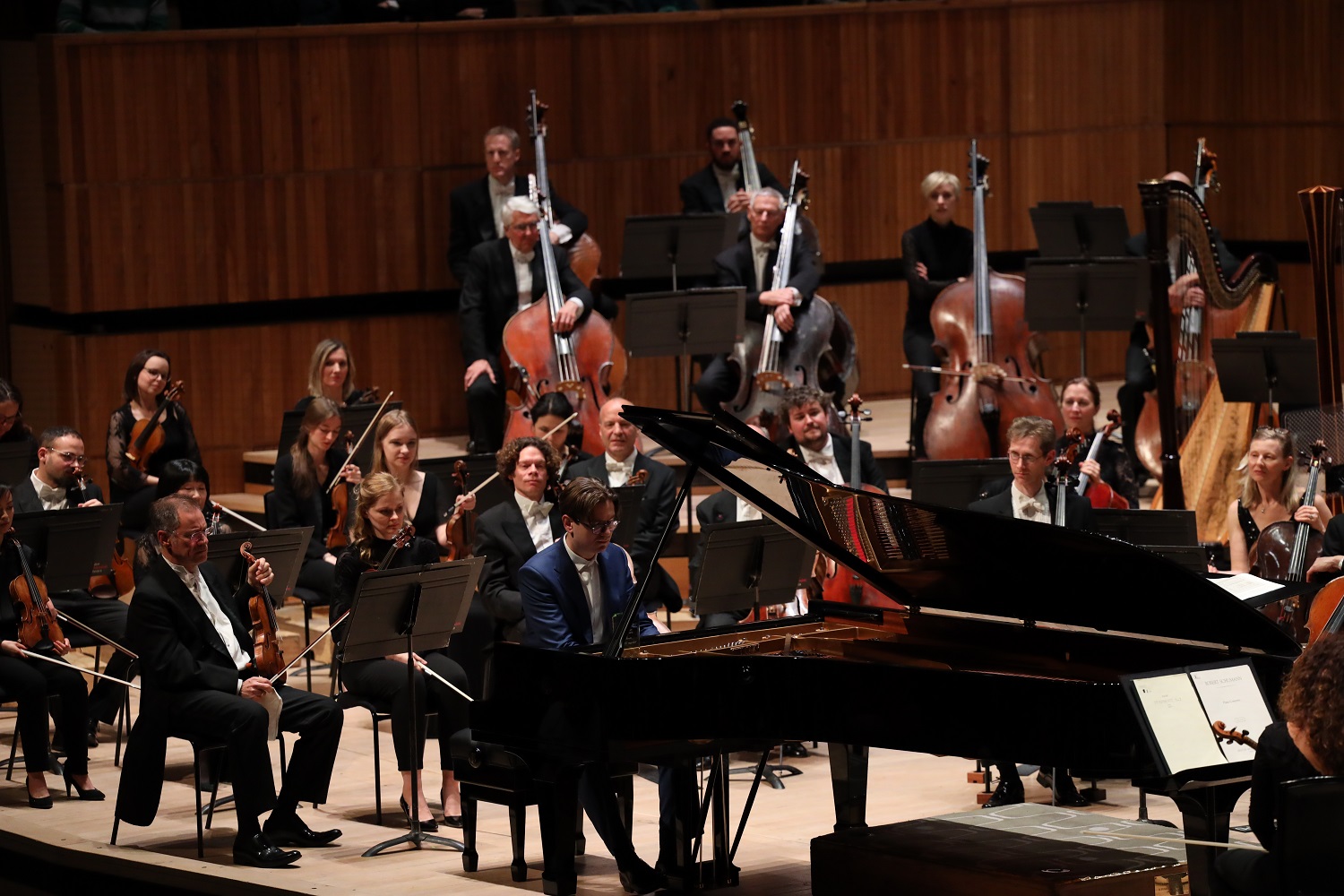 Elgar’s Second Symphony is familiar territory for both orchestra and conductor. Given the weight of tradition, it is unsurprising that Gardner did not make any huge interpretive interventions, giving a big-boned reading that also felt reassuringly traditional. The orchestra were on top form throughout, the larger string section displaying more unity than they had in the first half, allowing Gardner to find details in Elgar’s colourful orchestration (the harps!), and without having to unduly restrain the brass.
The opening orchestral outburst set the tone, big and opulent, but without heavy accents from the brass. Gardner emphasised the work’s symphonic status by ensuring a continuity across each movement, the tempo adjustments subtle but always decisive. And climaxes blazed, thanks to the excellent horn section and to incisive but warm interjections from timpanist Simon Carrington. Generous melodies and warm textures characterised the second movement, sometimes to excess: the oboe obbligato was swallowed up by the brass, a great shame. In the third movement, Gardner focused on the many moments of stasis, exploiting the LPO’s fantastically even and clear string textures to maintain continuity, even as the beat seemed repeatedly to evaporate.
That trick came in handy in the finale too. Gardner began surprisingly slowly, and even when the pace picked up the music felt deliberate. But again, this highlighted those moments of stasis, when the melody appears only as fragments in the lower stings, and the rest of the orchestra seem to drift into nostalgia. The greatest of those moments is the work’s bittersweet coda. Here everything came together: those finely controlled orchestral textures, perfectly balanced, gently swelling to each passing phrase. Gardner was in his element here, perfectly controlling the atmosphere of this music, so poignant and resigned. A captivating ending, and for the last five minutes, he held the capacity audience in the palm of his hand.